- Application Deadline:March 1
- Program Code:142.D0
- DEC in:Radiation Oncology
- Certification:Ordre des technologues en imagerie médicale, en radio-oncologie et en électrophysiologie médicale du Québec
Canadian Association of Medical Radiation Technologists - Program Length:3 years
If you would like to:
- Prepare for a rewarding career as a healthcare professional
- Learn to treat patients using sophisticated equipment
- Learn in small class settings with one-on-one attention from teachers
- Plan and administer treatments using specialized apparatus in radiation oncology
- Experience clinical practice in the workplace during your third-year stage
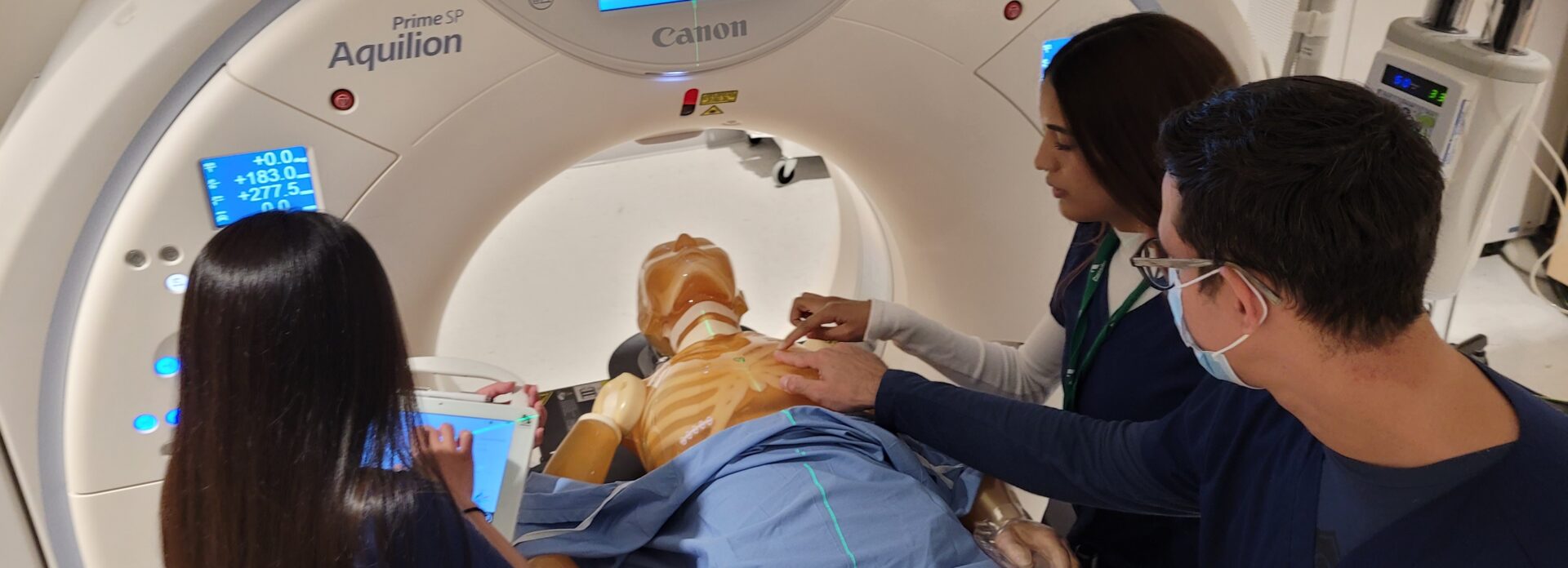
- Study with modern equipment that simulates hospital equipment
Then the Radiation Oncology Program could be for you.
The Radiation Oncology Program will prepare you with the knowledge and skills necessary to work as a radiation oncology technologist. As a healthcare professional, you will care for patients undergoing radiation therapy over the course of their treatment. You will learn to adapt to a variety of work environments and rapidly changing technology. Students will graduate with the ability to use radiation oncology to cure or improve the quality of life of patients.
The teaching staff and state-of-the-art facilities, paired with inspiring clinical experiences, helped me become a skilled and empathic clinician.— Peilong Z.
What you will learn?
- To participate in the healthcare process in the radiation oncology environment
- To safely use ionizing radiation for the treatment of cancer and benign conditions
- To educate patients and their families with respect to their radiation treatment process
- To work effectively as part of a team of healthcare professionals
- To ensure the well-being of patients by providing humanized care through cultural sensitivity
- To establish a valuable patient relationship and provide treatment management within the scope of practice of a radiation oncology technologist
Where will this program lead you?
Graduates of the program often pursue careers as radiation oncology technologists in areas such as virtual planning, CT simulation, dosimetry and brachytherapy. Other options include employment as hospital administrators, commercial representatives, academic or clinical educators as well as researchers and faculty in higher education.
Others continue their education at the university level in programs such as Biology and Physics. Additional prerequisites may be required in some cases.
What else you should know?
Once admitted to the program, students must:
- Complete 24 hours of volunteer work in a care-centred environment
- provide proof of a complete immunization record
Upon successful completion of a certification exam, you will become a member of Ordre des technologues en imagerie médicale, en radio-oncologie et en électrophysiologie médicale du Québec. You can also become nationally certified by the Canadian Association of Medical Radiation Technologists, which will allow you to be recognized anywhere in Canada as a radiation therapist.
What do you need to apply?
- A Diploma of Secondary Studies (DES) or academic background judged equivalent to the DES
- Sec V Mathematics - Technical & Scientific option or Science option 564-506 or 565-506
- Sec IV Environmental Science & Technology or Environmental Science 558-404 or 558-402
- Placement at College English 101 and Basic French 100 (testing may be required)
- Interview*
*An interview may be required.
Application Deadline
March 1