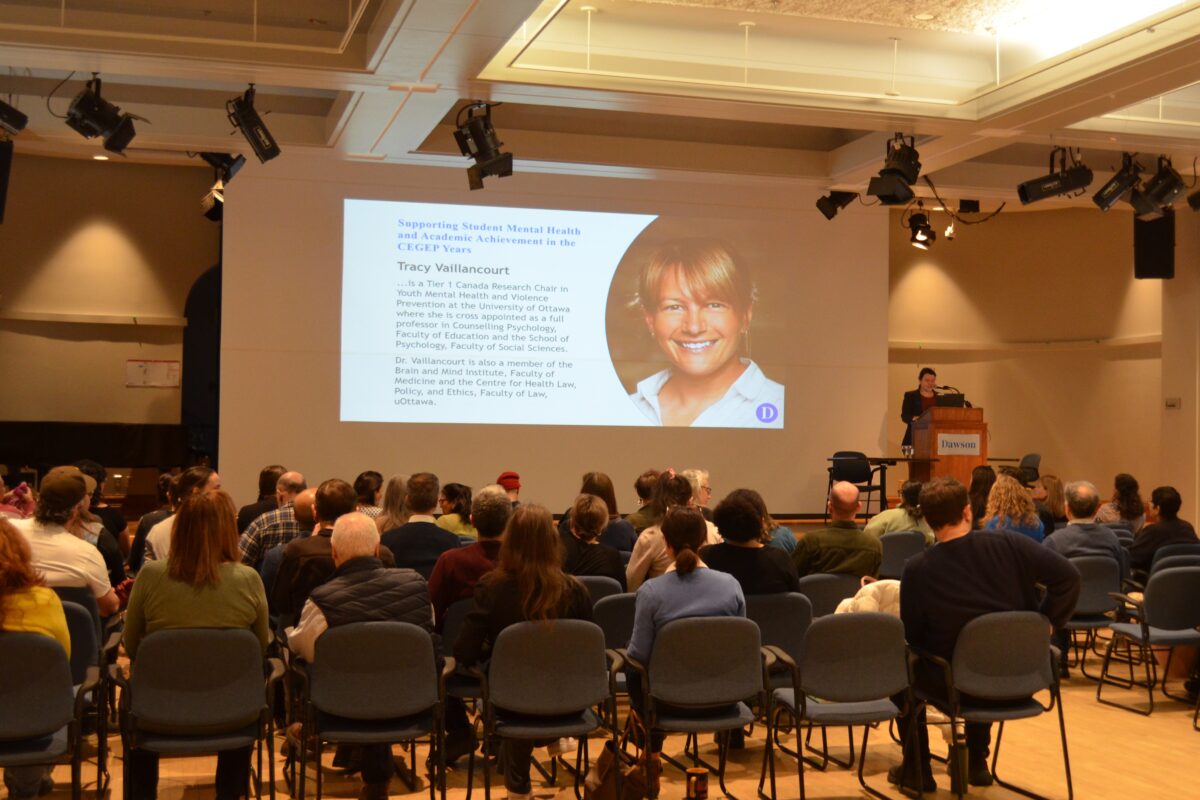
We’re in “the business of mental health”: Ped Day keynote speaker
The mental health of CEGEP students has been deteriorating in recent years and continues to be a major issue even years after the pandemic. Dawson Ped Day keynote speaker Dr. Tracy Vaillancourt listed several contributing factors, such as social media, relationship thinning and developmental mismatch and provided some practical things teachers can do to counter these influences.
Speaking to a room full of Dawson faculty and staff on Jan. 14, Dr. Vaillancourt told them their students are “in the thick of it where there is not yet a fully formed prefrontal cortex,” which supports executive functions like planning, impulse control, weighing consequences, and regulating emotions. They are also in the age group when mental health issues peak.
The Canada Research Chair in Youth Mental Health and Violence Prevention at the University of Ottawa says that CEGEP students today are experiencing greater levels of stress and anxiety than any previous generation. Added to that is the social comparison and social contagion fueled by heavy social media use.
Before the pandemic, one in five young people faced serious mental health issues; today, “Canada ranks 31st out of 38 economically advanced countries” for youth mental well-being, she said. Rates of depression and anxiety rose up to 30 percent during the pandemic and remain high.
Mental health concerns also have long-term effects: youth with high anxiety symptoms in high school were found to be 20 times more likely to develop depression as adults. Meanwhile, access to services is limited.
Dr. Vaillancourt emphasized that educators play a direct role in prevention. “I always say that educators think they’re in the business of education, but you’re also in the business of mental health because the prevalence is so high.” She encouraged teachers to act as “surrogate prefrontal cortices,” helping students reframe thinking and build resilience through routine, transparency, and consistent expectations.
Reducing avoidance behaviors, maintaining high expectations with strong support, helping students feel they matter, and fostering in-person social connection can all buffer against anxiety and distress.
“Resilience increases with a strong bond with a competent adult,” she reminded the audience. “You may be their best moment, their best person.”
To learn more about the research, strategies, and practical tools shared in her keynote, Dawson faculty and staff can visit the Ped Day resources here. https://collegedawson.sharepoint.com/sites/PedDays/SitePages/Ped-Day-W2026.aspx
Photo credit: Vanessa Lyness