Student interview with artists in “Elephant” exhibit at Dawson’s WGF Gallery
“Elephant” is the current exhibition at Warren G. Flowers Gallery – Dawson College (running until May 1, 2026). The exhibition brings together works by Joshua Vettivelu and Alex v. Pouliot to explore “how experiences of desire, anxiety, love, damage, and repair accumulate in the spaces we inhabit.”
The questions for the following interview were written by Visual Arts students Bethany D’Souza and Ana Luiza Strazzi Nogueira.
Question for Joshua Vettivelu and Alex Pouliot:
The title of the exhibition alludes to what “invisibly structures a room.” You both exhibit pieces that contain architectural elements. Why and how were these works curated within the exhibition space to comment on how we frame ourselves and one another?
In general, I’m really interested in how immaterial experiences of power eventually become physical things, like borders, prisons, community gardens, and even art galleries. My interest in architecture stems from the idea that the buildings that shape our social lives (for better or worse) are the product of the language we use to determine value. Oftentimes, the power dynamics that shape these spaces are rendered invisible. When things cannot be named/identified, they are able to operate without interference.
Alex and I decided to title the exhibition “Elephant” as a reference to the idiom “elephant in the room”, to explore how power is a substantial presence that can be felt but remains invisible and unnamed.
Questions for Joshua Vettivelu:
A lot of your artworks possess an archaic quality in the materials that are being used (i.e. stoneware, terracotta, metal, leathers). Is the employment of these historical materials pertinent to the messages you’re trying to convey?
We learn a lot about the social lives of past civilizations through the material records they kept. In this way, I am very interested in making the ephemeral social dynamics of our present moment archivable by using materials that have the potential to survive the future.
The images used in the clay tablets are all taken from real images of men interacting with each other. Within these images we can view the social lives of men and see some of the rituals men use to regulate each other, creating hierarchies through humiliation, dominance, or camaraderie. Sometimes I fantasize that these clay tablets will be discovered in the deep future, providing future civilizations a glimpse into how we understood ourselves and our own undoing.
Leather also has an interesting (albeit morbid) relationship to time. Leather is another way to extend what was once alive, but deemed killable, into the future. I am interested in how our society transforms life into extractable resources. The leathers I use are from snakes and eels that have been caught in industrial ocean fishing. These creatures are the “accidental” and unwanted catch of industrial extraction and are killed and turned into leather to provide some profit from their undesirability. Generally speaking, these creatures that slither on their belly, are alien (and sometimes even threatening) to us, making it hard to empathize with. This lack of empathy rationalizes the devaluing of life into extractable resources or collateral damage. I believe this dynamic repeats itself in many ways, including our relationship with the environment, other animals, and each other.
While the left side of the gallery space is dominated by your work, it exists alongside Pouliot’s sculptures Bag of lemons and Apart. Does this help build a narrative in a sense or create an inference with it being adjacent to your work? This can be answered along with Pouliot as he also has one of Vettivelu’s works on his “side” of the gallery space.
I’m a really big fan of Alex’s work, so being able to have our work in conversation with each other is a real honour. As we were putting the show together, it was very important for us to make sure that our works reflected the conversations we both have with each other. For me, Alex’s work represents a deep personal exploration of what determines value, force, and hope. “Bag of Lemons” features a bag of unused lemons that have been gilded and contained with precious metals as a way to preserve them. Here, themes of life, loss, and preservation reappear. I understand Alex’s approach to gilding (or making precious) things that have gone to waste as a beautiful exploration of the kinds of agency we have to change the value of things that are deemed invaluable.
Questions for Alex V. Pouliot:
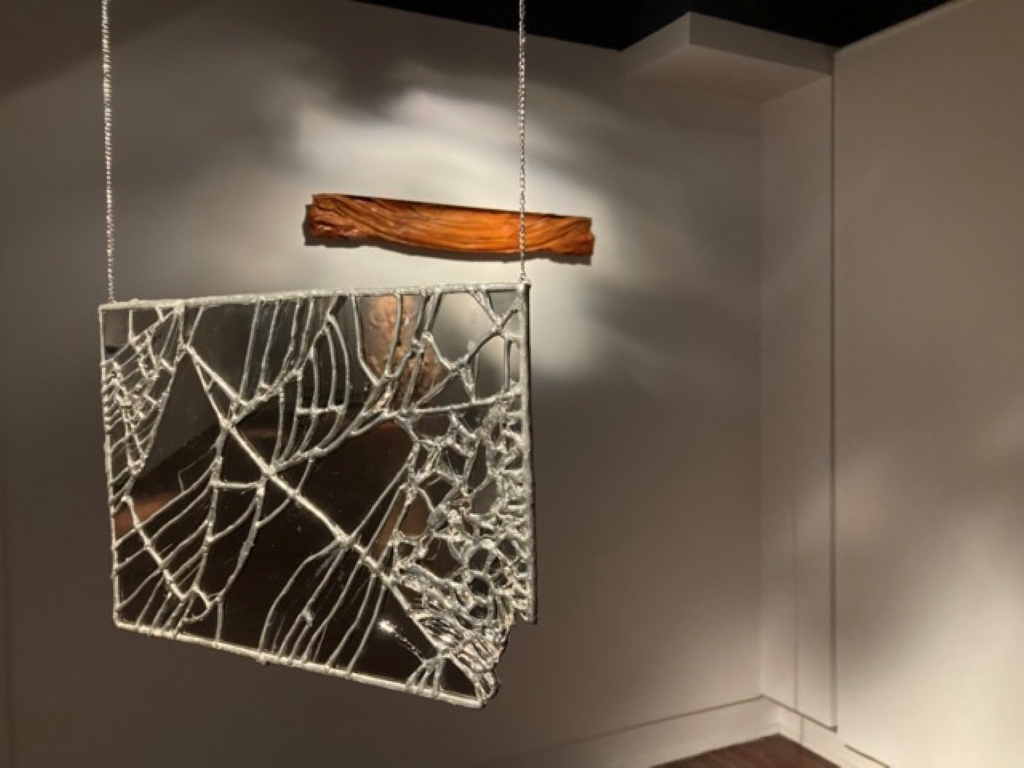
Your artworks Through the Looking and Dead Ringer are beautiful two-way mirror installations that create interesting and dynamic shadows. How would you describe your artistic process of creating these sculptures and defining the shapes/contrast of the shadows?
All of the soldered glass pieces shown in the exhibition are a testimony of my apprenticeship of the stained-glass copper foil technique. Wanting to learn this craft, without having to think about the shapes of the work I would create and the colour I would use, I restrained myself by using only found clear glass. In wanting to work with such a fragile material, there was a lot of trial and error and still are. So, to learn, I broke [the] glass and repaired it. What is left to see is the result of a negotiation between matter and my desire to control it, like the scars of destructive and healing process.
What characterizes Through the Looking and Dead Ringer is that they were shattered by the same impact. Taped to one another, like a final embrace before their fall, they were dropped on the concrete floor of the studio together. That is why they share similar fractures. They resemble one another, yet they are different. Like twins. What sparked this idea was simply the fact that I had two identical pieces of this thick two-way mirror. They felt so different from the glass I was used to working with that I wanted to highlight their specificity through a shared trauma.
The shadows, like most of what I do, are the result of happy accidents.As mentioned in your biographical description, you are a part-time sorcerer who wishes to “reclaim the magic of art.” Through your various multimedia sculptures, how do you implement this part of your life?
Your question makes me realize that maybe “sorcerer” is not the best term. I used that word for a lack of a better one to highlight the magical aspects of making art, especially when creating immersive multimedia installations I find. We are so used to benefiting from technological advancement that they become part of our everyday life, and we fail to see its magic. If most of our everyday technology would exist in medieval times, it would certainly be considered the highest form of magic without any doubt and would create strong emotions to anyone experiencing it. I feel as a child I could feel that way towards new things, where the border between reality and fiction was very porous. For me, reclaiming the magic of art is trying to wake up the inner child of viewers, by creating a suspension of disbelief.
Ultimately, even materials in their purest form affect the body and our understanding of a space in different ways. Just as a piece of metal does not have the same presence as its wooden or ceramic counterpart, I see the role of the “sorcerer” as someone who brings together the combined (magical) effects of all the materials in a work to produce new effects and meaning.