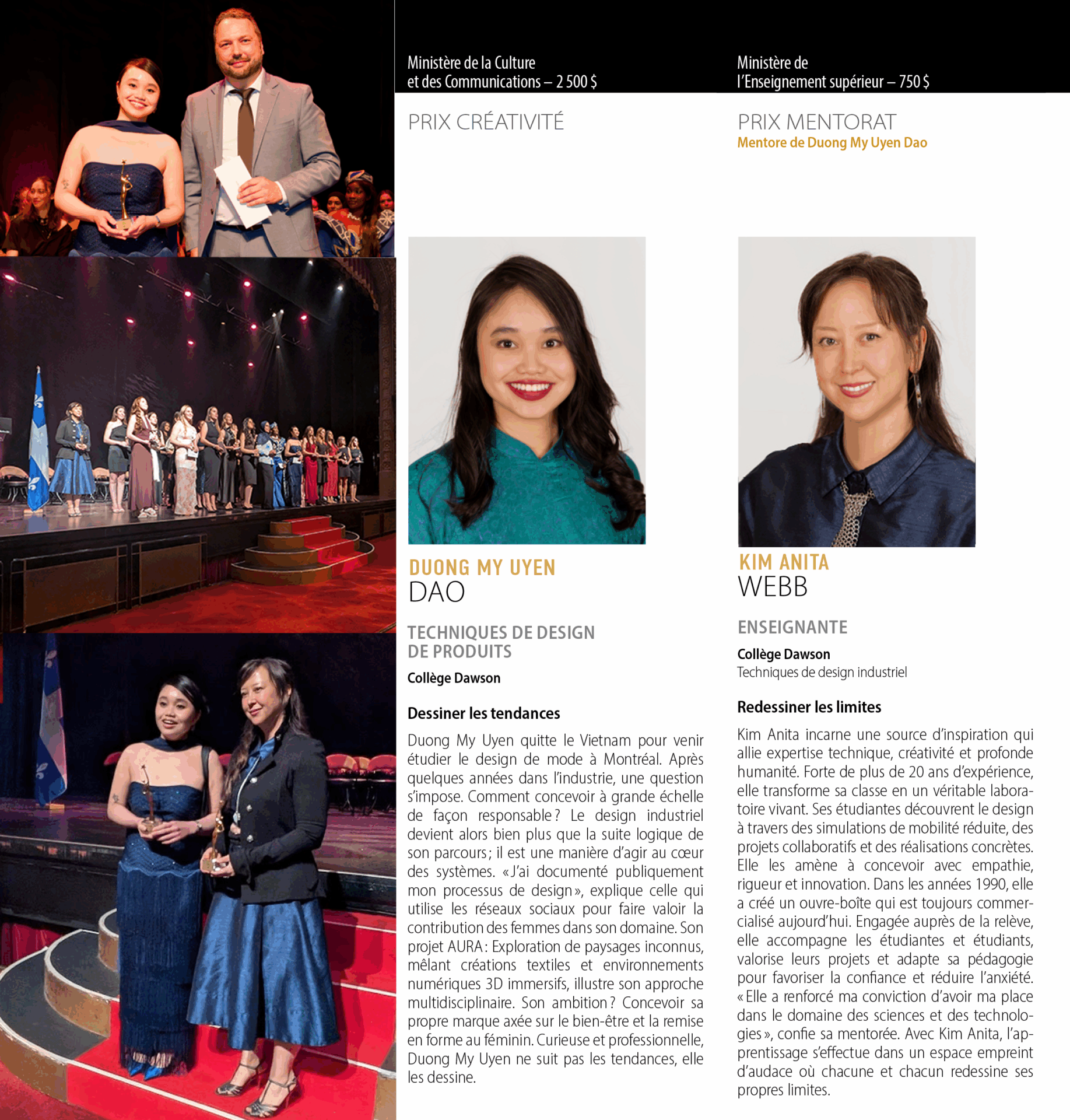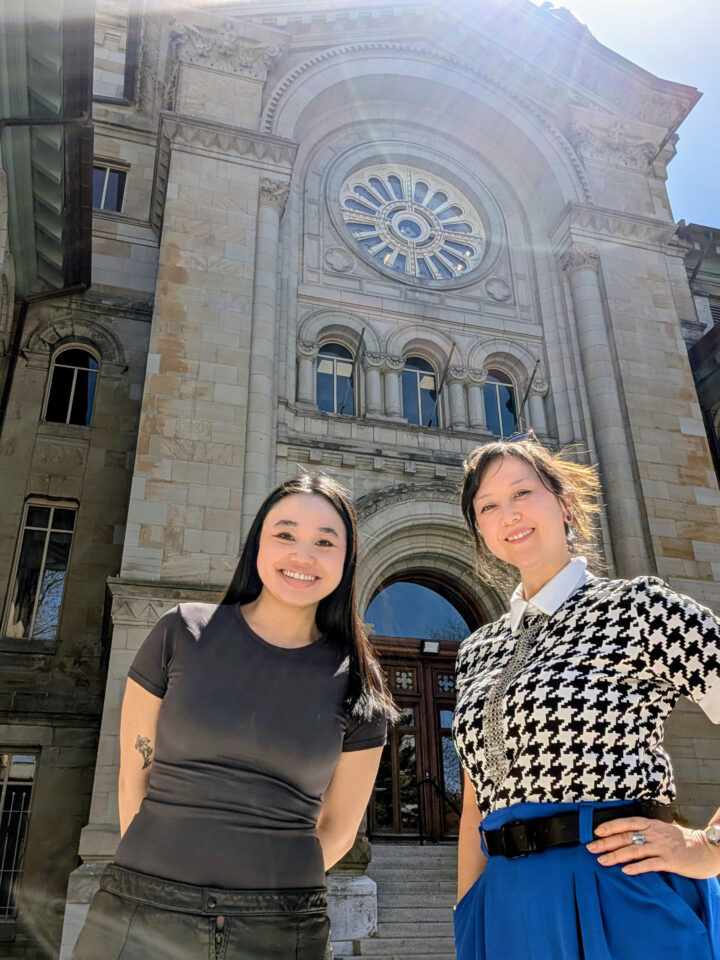
Product Design student and teacher win awards for women in STEM
The determination and creativity of Dawson College Product Design student Uyen Dao have earned her the Prix Excelle Science, presented by the Ministère de l’Économie, de l’Innovation et de l’Énergie as part of the Chapeau! Les filles 2026 contest. The annual awards recognize women who choose careers and fields of study traditionally dominated by men.
Uyen described the recognition as the first “bloom” of her efforts and said it reassured her that she is on the right path after years of persistence and growth. She chose Dawson’s Product Design program after realizing she wanted to do more than style products.
“I wanted to understand how things are made, how they function, and how they impact the world,” she said.
At Dawson, she learned that design is a process of testing, failing, refining and improving ideas. “Product Design also taught me entrepreneurial thinking—how to build something from nothing, from ideation to execution,” she said. “It gave me the mindset that design is not only about objects, but about designing systems—and even designing your own life.”
The influence of a mentor
A significant influence on Uyen’s development has been Product Design faculty member and product designer Kim Webb. When Kim graduated from the program, she only one of three female graduates. Today, women make up about half of those enrolled in Product Design at Dawson.
In her Chapeau! Les filles application, Uyen highlighted Kim’s role as a mentor, educator and role model. Her description of Kim also contributed to Kim receiving the Prix Mentorat pour la Formation Technique award:
“Ms. Kim, the only full-time female professor in our Product Design department, represents the future I aspire to help build. With over 20 years of experience, she entered the field when female representation in Product Design was even rarer than it is today. Her presence alone is powerful, but what truly distinguishes her is the way she integrates technical mastery, mentorship, and representation. In her ergonomics class, she transforms theory into interesting experiences. When we studied design for elderly users, she introduced simulations where individuals wore physical limitation suits that mimic reduced mobility and strength. Rather than memorizing ergonomic principles, we conducted experiments and developed design proposals grounded in empathy. Through these immersive exercises, she taught us that meaningful design begins with understanding human vulnerability.
Ms. Kim consistently creates interactive, hands-on learning environments aligned with the active nature of industrial design. She organizes interdisciplinary collaborations, including sustainability initiatives such as designing and constructing a butterfly dome nursery on campus. By forming student teams to conceptualize, prototype, and build the structure, she turned our school into a living laboratory. These projects strengthened our environmental awareness, teamwork, and problem-solving skills.
Finding confidence in a technical field
Like many women entering traditionally male-dominated fields, Uyen overcame many obstacles.
“One of the biggest challenges was overcoming my own limiting beliefs,” she said. “I wasn’t exposed to technical skills like mechanics, tools, or machinery growing up, so entering Product Design initially felt intimidating. The environment can also feel less ‘glamorous’ compared to fields like fashion.”
Rather than allowing those concerns to hold her back, she committed herself to developing technical skills through practice, projects and hands-on experience with tools and machinery.
“However, I chose to face that discomfort directly. By consistently practicing, working on projects, and engaging with tools and machines, my confidence grew significantly,” Uyen said. “Over time, I realized that I don’t need to fit into the field—I can contribute to changing it. There are industrial standards to follow but I will find ways to adapt and set my own rules.”
Encouraging more women to build and design
Today, Uyen hopes to inspire other young women to pursue careers in industrial design, technology and STEM fields. Her advice is simple:
“Don’t overthink it—you are more capable than you think. … Stay connected to yourself. Take care of your body, trust your intuition, and use your empathy as a strength. STEM and design are not only about logic—they are about understanding people and improving lives.
“Be bold in expressing yourself and don’t be afraid to take space. The world needs more women building, designing, and leading.”
The award has strengthened Uyen’s commitment to increasing the visibility of women in industrial design. Through her social media presence (find her on Instagram at @designer.uyendao), she documents her experience with prototyping, machinery and product development while showing that technical expertise and personal identity are not mutually exclusive.
She believes her application stood out because it focused not only on achievements, but also on personal growth, tracing her path from fashion design to product design and emphasizing perseverance, curiosity and the courage to change direction. She also pointed to the impact of sharing her journey publicly, noting that one of the most meaningful moments came when someone told her they had decided to pursue graduate studies in industrial design after following her work online.
“That demonstrated real impact, and I believe it strengthened my application.