Journeys supports more Indigenous students’ transition to college
Thanks to outreach efforts and faculty members who have woven experiential and land-based learning into the curriculum, Dawson’s Journeys program has attracted enough students to launch two cohorts for the first time.
“Journeys is a great way to learn in CEGEP if you need to gain some credits to get into the program of your choice or if you are unsure about college and would like to give yourself the best chance of succeeding,” said program coordinators Anjali Choksi and Jennifer Savard, along with academic advisor Michele Pallett, members of the Journeys team.
Word of mouth from current and former students who value their experience in the one-year transition program for Indigenous students appears to be a major factor in the program’s growing popularity. Journeys students often encourage siblings and cousins to apply. Through the program, students can complete academic prerequisites, earn credits and receive close support as they adapt to post-secondary life in Montreal.
“They learn in a smaller group with other Indigenous students,” the Journeys team says. “The objective of our program is that students should understand and learn that Dawson is a place where they can feel at ease and supported to flourish while they learn. Students take most of their classes together, so they get to know Indigenous students from other nations. The First Peoples’ Centre is where they gather to build even deeper community.”
“We have developed very good relationships with school counsellors at quite a few of the Indigenous high schools,” the Journeys team says. “Within the English and Physical Education classes, we have included important experiential and land-based learning. The Physical Education courses have class outings in community.
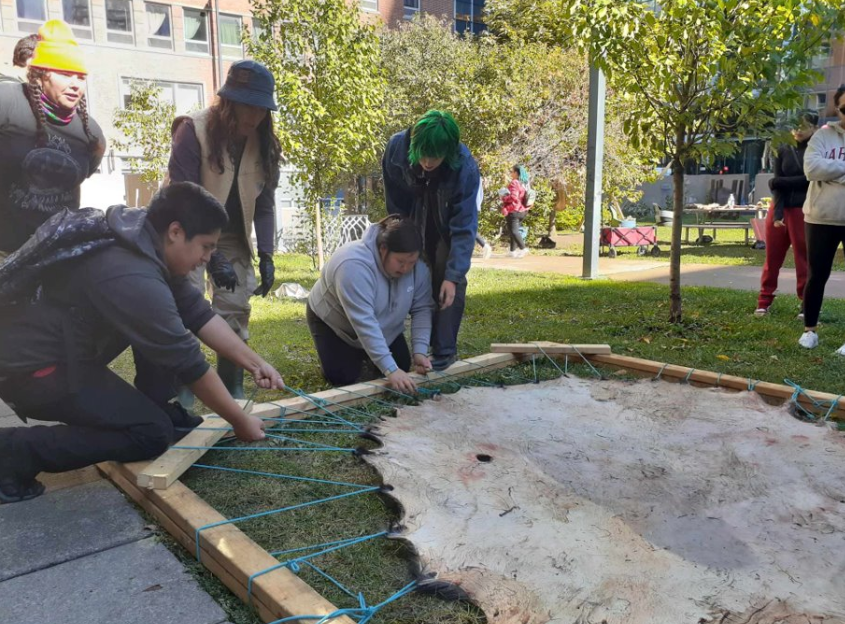
“In the Journeys English class, Indigenous scholar Amanda Lickers, Seneca from Six Nations, assists students in their transition to CEGEP, finding their voice, learning skills like tanning and recognizing Indigenous vitality through research creation. The class also works closely with AbTec (Aboriginal Territories in Cyberspace) at Concordia to create stories and spark their creativity.”
Students from Cree, Naskapi and Kanien’kehá:ka high schools visit Dawson each year for campus tours, including a stop at the First Peoples’ Centre. “We make sure that at least one of us is available to explain the benefits of the Journeys program and our pedagogical philosophy,” said Anjali, Jennifer and Michele.
A key question prospective students and their families often have is what kind of support is available at Dawson. The Journeys team is confident students will find the help they need: “There is a lot of support. The support team for Indigenous students and the Journeys team work closely to ensure student well-being. An English teacher is available for English support; a French teacher is available to provide French support.
“Tiawenti:non Canadian and Jessica Quijano in the First Peoples’ Center provide constant support to our students. They help them to navigate Montreal, as many of them have never lived here, and to figure out the College. They also provide psychosocial support. Reyana Hadef provides support for students taking Math and other science courses. Vanessa Kwalar, who works in the First People’s Center, was hired this summer to provide academic support. The three of us are also available throughout the year to provide support for students and many of them text us for help.”
The Journeys team says the program’s success is reflected in its graduates: “We see them happy and flourishing after they graduate from Journeys at Dawson.”