Dawson community survived its worst day through resilience, compassion and well-being for all
Wednesday, Sept. 13, 2006, began as a beautiful sunny day. Then, “a lightning strike came out of nowhere,” said Richard Filion, who was Director General of Dawson College at the time.
Many Montrealers, Quebecers and Canadians know what happened that day, and many who are old enough remember it vividly. Student Anastasia De Sousa was killed, 19 others were wounded, and countless students, employees, families and community members were profoundly affected by the events that unfolded at the College. A research study revealed that nearly one-third of students and staff suffered from psychological trauma in the years after the event.
Less well known is the story of how the Dawson community responded in the days, months and years that followed and how that response helped shape a lasting vision of well-being, resilience and peace.
For many members of the community, the tragedy became a catalyst for reflection about the purpose of education and the strength of human connection.
“This awful day brought the best out of so many people,” said Chris Adam, retired manager of the Office of Sustainability and a teacher in the Community, Recreation and Leadership Training program at the time. “It underlined the notion that giving back whatever you could − time, money, a specific skill set − and creating a supportive learning environment is contagious.”
Chris said the events of Sept. 13 reinforced questions he had long considered about the role of education.
“I have always thought that the greater purpose of education was to develop responsible citizens with some general enduring body of knowledge that could help them get through life,” he said. “The tragedy solidified this notion in me and ultimately fused my commitment to focus on relationships of all kinds, both within the discipline I taught and the college community.”
Leadership at every level
What stays with Diane Gauvin, all these years later, is the pride she felt in the resilience of the Dawson community.
“Hierarchy is not necessarily what dictates leadership,” she said. “There are emergent leaders, people who rise to the occasion. Richard was an excellent leader at the time who allowed these emergent leaders to take action.”
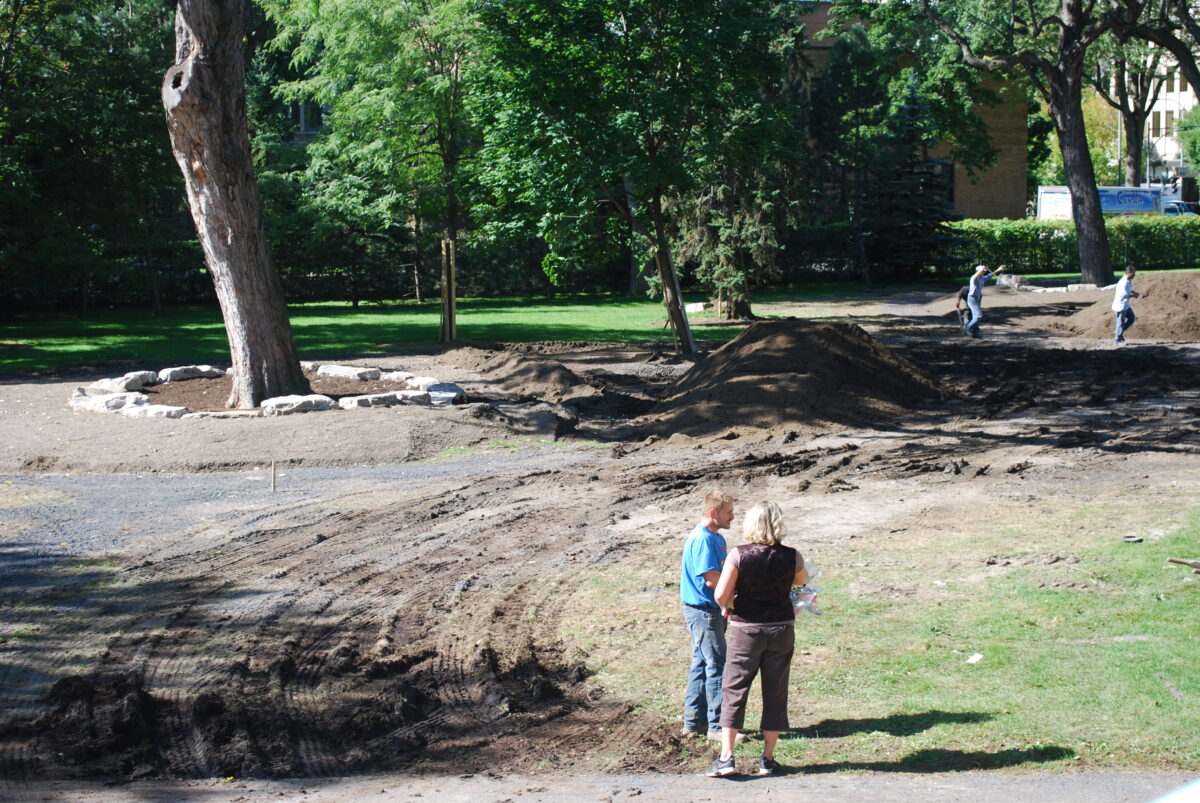
One of those emergent leaders was Chris Adam, who helped mobilize the vision for what would become the Peace Garden, a beautiful garden composed of three eternity circles, including Anastasia’s Garden, on the northwestern corner of the campus near Sherbrooke Street West and Wood Avenue.
“The Peace Garden was constructed with hundreds of volunteers each month and helped the Dawson community create a living library for the College,” he said. “Support for this concept college-wide under a new sustainability initiative was a significant endeavour that helped many students and staff. Malaka Ackaoui, landscape architect and urban planner with WAA Inc., generously donated plans for the placement and construction of the garden while Cindy Elliott, of the Office of Sustainability, was tireless in her garden floral design work and planting program for many years.”
At the time, Diane Gauvin was Dean of Social Science and Business Technologies. She would later serve as Academic Dean and then Director General, succeeding Richard before retiring in 2025.
On Sept. 13, her instinct was to find where she could be of greatest help.
“I decided to go to the hospital,” she recalled.
Although visitors were not being admitted, Diane was let in since she was representing Dawson. She was invited to meet with the head of psychiatry, Dr. Warren Steiner.
“Dr. Steiner was key in our response,” Diane said. “We followed everything he advised us to do.”
To support the return of students, employees and faculty to campus, more than 100 psychologists and mental health professionals were available in the Library.
Heroes among us
In the days immediately following Sept. 13, stories of courage and compassion emerged across the Dawson community.
“Dawson students and employees helped each other reach safety, protected each other in closed classrooms and offices,” recalled Donna Varrica, Dawson’s retired Communications Director.
Donna also remembers a gathering of employees held two days after the shooting. “Don Walker, then Interim Academic Dean, captured the enormity of what had happened when he said: ‘We are all victims, and we are all heroes.’ These words resonate to this day,” she said.
For many community members, one image from those early days remains unforgettable: the return to campus.
“Hundreds, likely thousands of students, many wearing pink to honour Anastasia, crowded the entrance on de Maisonneuve,” Donna recalled. “Some were crying, some clutching flowers. Some came in alone, but mostly they entered surrounded by friends, classmates, teachers and staff.”
Director General Richard Filion, Don Walker and other employees greeted students as they arrived.
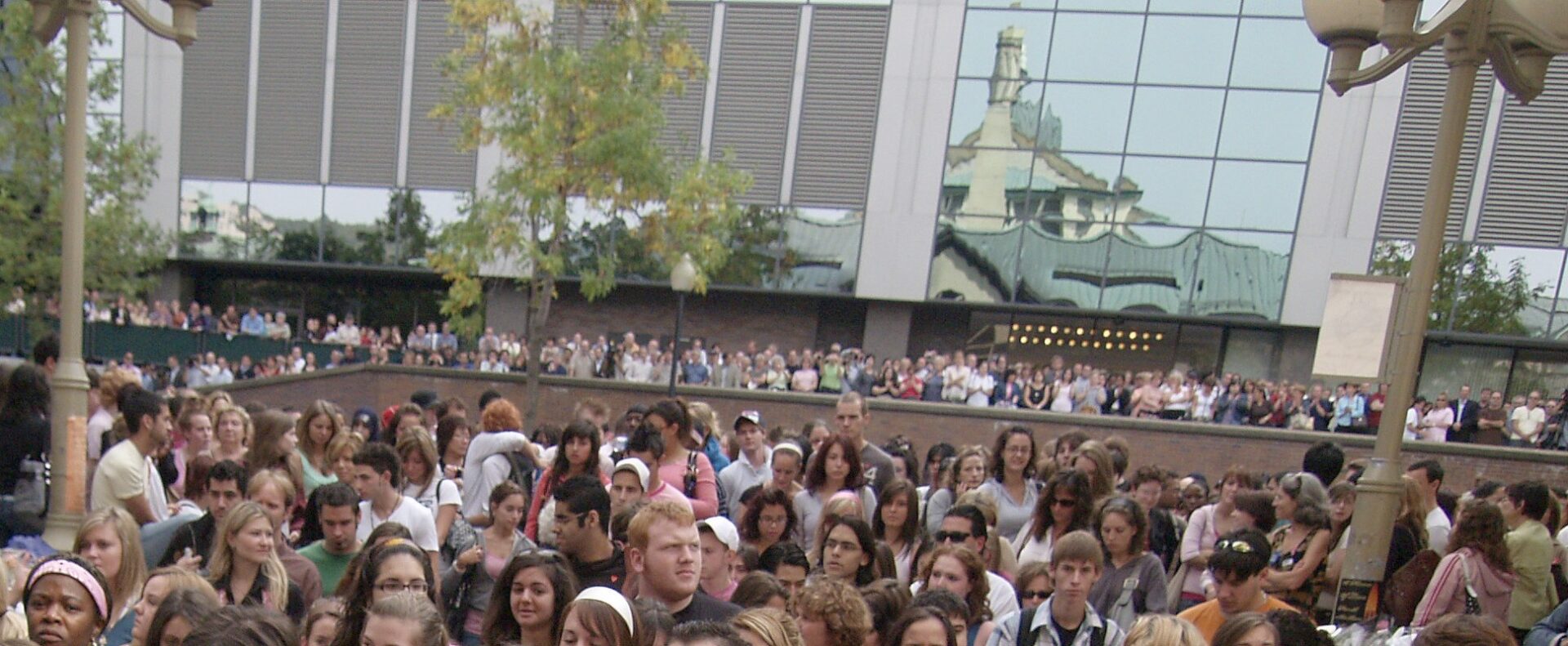
“It was solemn and orderly, but it also conveyed such a sense of hope for our future: this breathtaking display of young people taking back their school. It inspired us to create a safe, stimulating learning and teaching environment,” Donna said.
Faculty members played a major role in welcoming the students back and helping them persevere. Richard gives much credit to Leslie Barker, then Chair of Senate, who was very helpful in conveying faculty needs and concerns to decision makers.
A number of the survivors approached Donna at the 20-year commemoration event to express “gratitude towards the college for providing them with so much support, facilitating a return to school to continue their studies and the safe haven they were given in the Director General and Communications offices. For many, it was a vital part of the healing process, helping them find the courage to face the world again.”
In the immediate aftermath, there were calls to implement stringent security measures. “From day one, Richard said that we would not create a fortress at Dawson,” said Donna. “We were not at the wrong place at the wrong time; we were exactly where we were supposed to be. It was the shooter who was guilty of that. As a learning community, it was our responsibility to understand the roots of violence, to find solutions and a path toward peace and non-violence.”
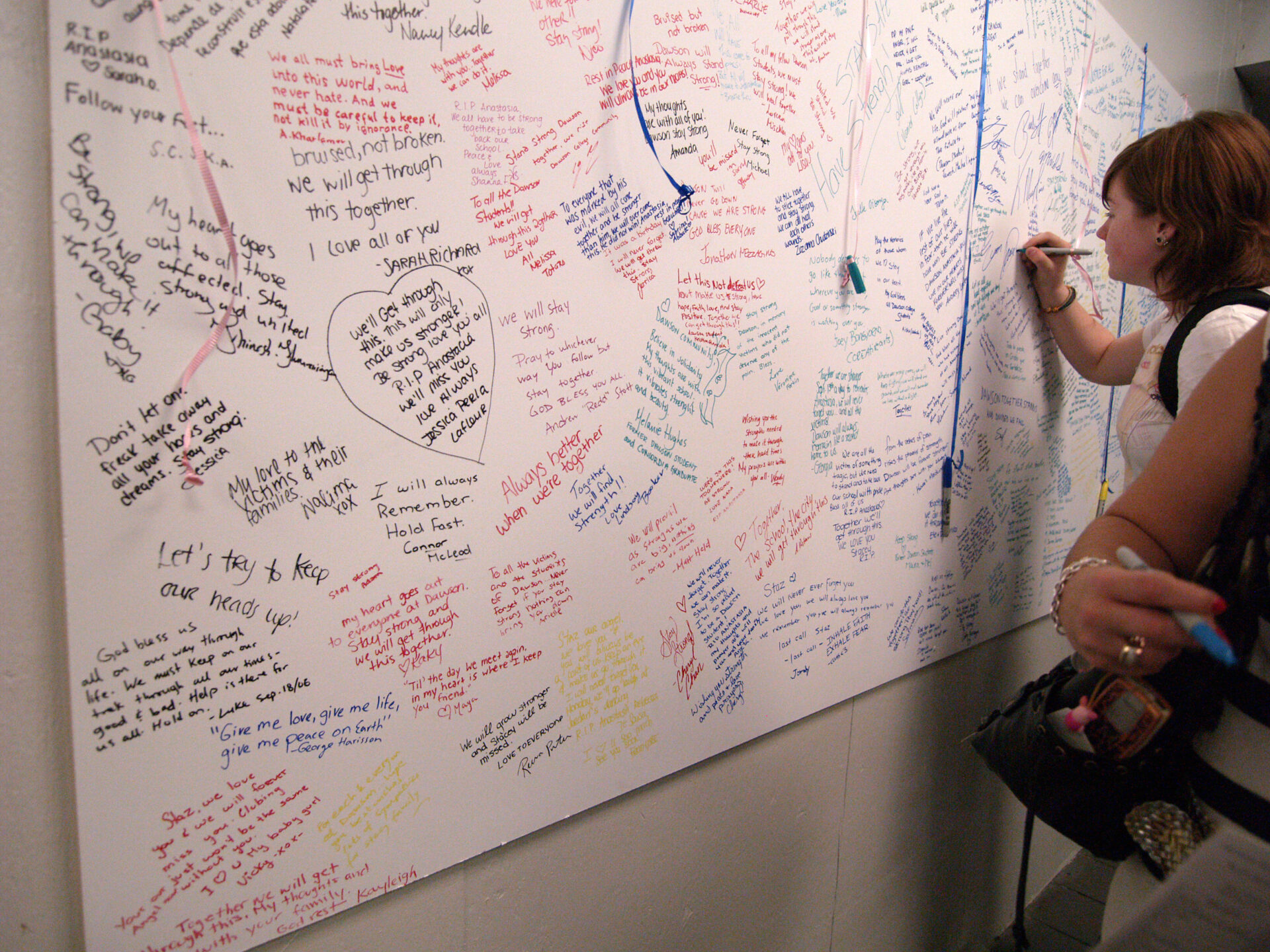
For Diane, returning to Dawson’s core mission provided a sense of stability during those difficult days.
“Why are we here? We’re here to educate,” Diane said. “That’s our main objective so let’s focus on that.
Diane had joined Dawson as a teacher eight years before the tragedy, and the experience deepened her connection to the College.
“There was no playbook for what we were doing, but the community trusted us to make the best decisions,” she said. “The Dawson community was very compassionate. They knew we had the best intentions. Everyone came together.”
Building something beautiful
Many of the initiatives that followed were rooted in a collective determination to move forward while honouring what had happened. These outcomes include the Peace Studies Certificate, the Office of Sustainability and a resilient community that is animated by the “spirit of Dawson.”
“The first thing that I remember happening was making a commitment to peace and non-violence constructive and concrete,” Donna said.
While there were discussions about creating a plaque, monument or traditional memorial, teacher Chris Adam proposed a different idea: a living memorial that would serve as a teaching and learning space and reconnect people with Nature.
That vision became the Peace Garden.
“A bit later, Chris brought in Brian Bronfman and his foundation to explore possibilities for different initiatives,” Donna recalled. “I remember it being a period of some serenity and solidarity. We were working toward creating a beautiful thing to get past the ugliness that had befallen the College.
“It was something to do, something physical to plant the seeds toward healing and to watch it grow. It was wonderful to see members of the community out there at lunchtime, early in the morning and late afternoon after the workday was over, outside in billy boots digging in the dirt, creating this oasis.”
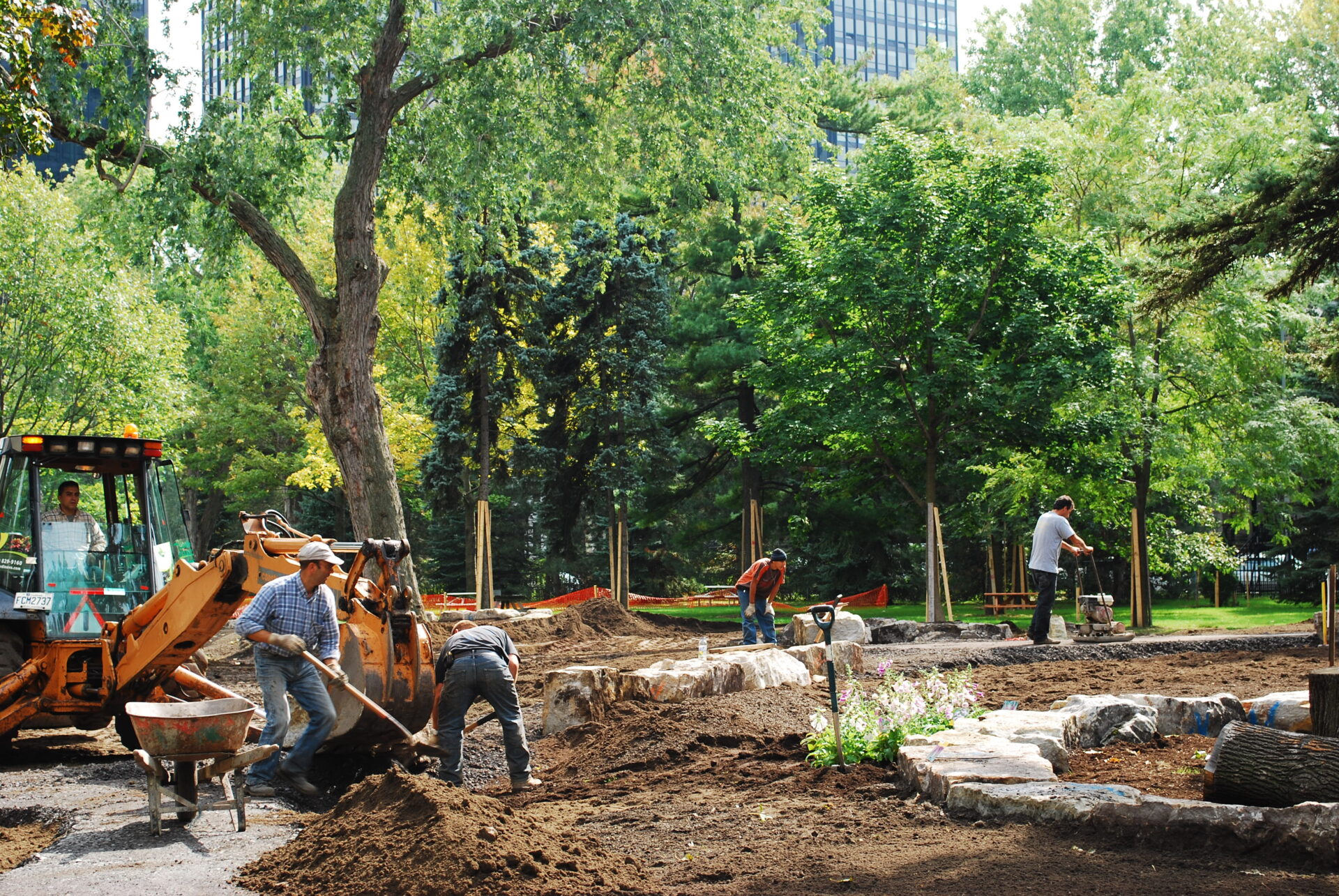
The Peace Garden vision becomes a reality (Chris Adam)
A legacy of well-being
The values that emerged from those years eventually became woven into Dawson’s institutional culture.
Under Diane’s leadership as Director General, well-being for all became an overarching value in the College’s strategic plan.
“For the employees, Dawson College is a milieu de vie,” she said. “It is important to take care of our people. Anything we can do to make life better for employees within the constraints, we should do. People are handling a lot of stress, whether it be at work or at home. What if we could be nicer, kinder?”
Today, that commitment continues through initiatives such as free recreational activities for employees and one hour of well-being time per week for all non-teaching staff.
Diane also sees that same focus on mission and well-being reflected in the way the community continues to face challenges, including Law 14 and budget cuts.
“We continue to be resilient and stay focused on our mission. Dawson is stronger because of what we experienced. We decided we would not let violence rule. This is a tight community that is resilient and hopeful.”
Chris believes the events of 2006 helped shape a lasting “spirit of Dawson.”
“I have the pleasure of working across Canada and internationally, and Dawson is associated with a special spirit, resilience and leadership that is often mentioned,” he said. “When I hear someone say, ‘I don’t know what it is, but Dawson has something special,’ I smile inside and am reminded of the caring and giving spirit that enveloped everything that transpired in 2006 and many years after that.”
An enduring legacy
“History, despite its wrenching pain, cannot be unlived, but if faced with courage, need not be lived again.”
For Donna, these words of poet Maya Angelou capture Dawson’s enduring legacy.
“The Dawson community’s resilience and determination to rise again, to be better, kinder, more creative, to be more open and more dedicated to meaningful activities, from yoga in the Garden to a conference that sought to explore how education could be the antidote to violence in our society and give our youth the tools to persevere and thrive.”