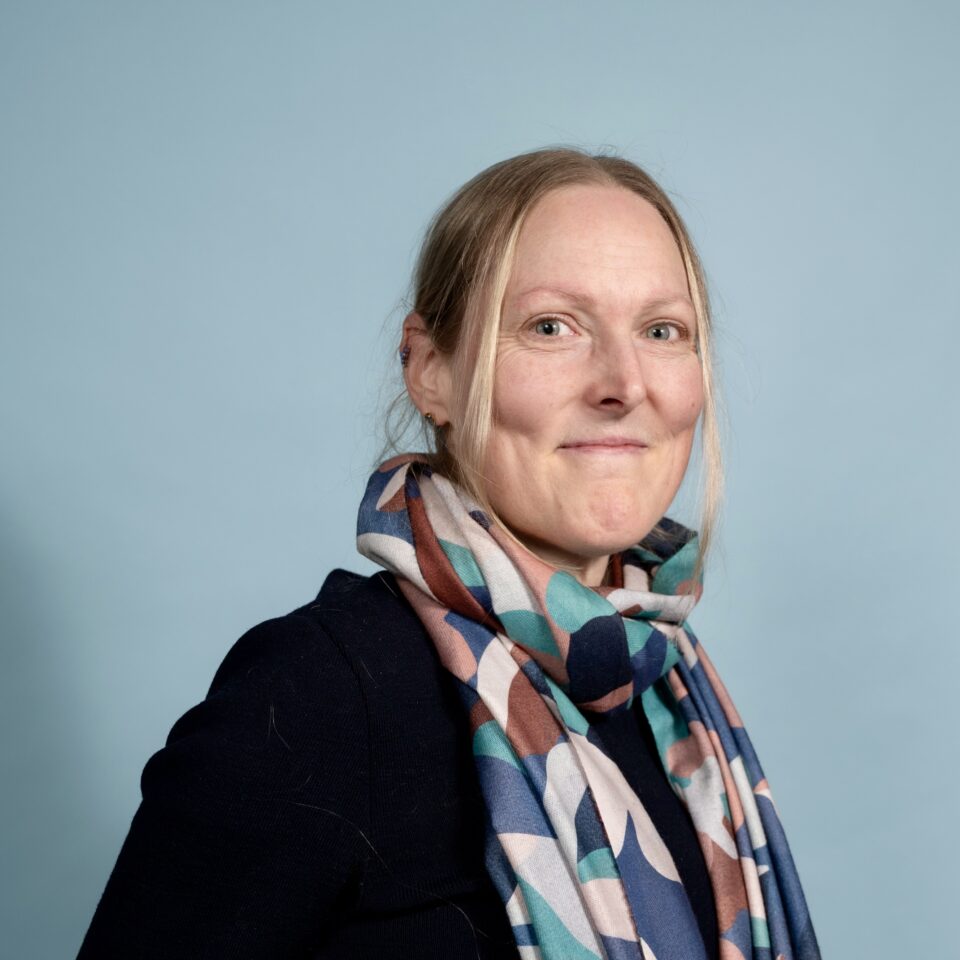
Dawson math teacher Mathilde Hitier earns top Quebec honour in mathematics education
Dawson Mathematics teacher Mathilde Hitier is this year’s recipient of the Dieter-Lunkenbein Prize, a provincial award recognizing the top doctoral thesis in mathematics education in Quebec.
Mathilde was recognized for her outstanding doctoral research in mathematics education, which offers fresh insights into the connection between mathematics and mechanics.
The award, which will be presented at the 70th AMQ Congress on Oct. 18, honours graduate research that advances the field of mathematics education in Quebec. The jury praised the originality of her work, the strength of its theoretical framework, the rigour of its methodology, and the practical recommendations it offers for STEM teaching at the college level and beyond. They also highlighted the exceptional quality of her writing and the significant contribution her research makes to advancing knowledge in mathematics education.
The Communications Office did an interview with Mathilde about this outstanding achievement. Here is the Q & A:
Tell us about your thesis.
Mathilde: My thesis explores the teaching and learning of the derivative, a key notion of calculus that measures how one quantity is changing with another.
A prototypical example is velocity, which describes how position changes with time. Students encounter velocity as a derivative in both their differential calculus and mechanics courses, which, at the time of the study, were both first-term courses in the Science program at Dawson.
Previous research showed conflicting views on the role of physics in learning calculus, with some studies suggesting that it supports understanding, while others pointed to additional difficulties, and I wanted to better understand how this important mathematical concept is used and conceptualized across disciplines, not only from a mathematics perspective. To answer this question, my analysis draws on three sources of data: from textbooks, from teachers, and from students.
My research shows that although both disciplines describe velocity and acceleration as derivatives, they often approach them in different ways, using different representations, methods, and problem-solving practices. As a result, students do not always recognize the connections and may develop fragmented understandings of the concepts involved. The study suggests that improving communication and alignment between disciplines, such as through the paired courses at Dawson, can help students build a deeper and more meaningful understanding of mathematics and its applications.
What were the most important findings or discoveries that emerged from your work?
Mathilde: One of the main findings is that, despite the fact that the derivative emerged, among others, through the study of motion by Newton, the study identified important differences in the types of tasks students encounter, the techniques they are expected to use, and the ways the concept is justified and explained. These differences help explain why building connections between the two courses can be experienced as challenging for the students. At the same time, the study showed that students are capable of bringing ideas from mathematics and physics together, particularly when confronted with unfamiliar situations, suggesting opportunities to better support those connections.
What does your research tell us about how students learn mathematics most effectively?
Mathilde: My research suggests that students benefit when they are helped to make explicit connections between ideas encountered in different contexts. Simply encountering the same concept in multiple courses does not guarantee that those connections will be made automatically. Students also seem to benefit from opportunities to move beyond routine procedures and engage with problems that require interpretation, reasoning, and the coordination of multiple perspectives. More broadly, I believe students need to understand not only how to do mathematics, but also what mathematics means and why it is useful.
What does this mean to you, personally and professionally?
Mathilde: This doctorate was quite different from my first one. While my earlier PhD was in pure mathematics and a natural continuation of my studies at the time, I chose to do this research out of intellectual curiosity and to grow as a teacher. Receiving this recognition means a lot to me, as it acknowledges years of effort and dedication.
Who were the mentors, colleagues, or students who helped shape your work?
Mathilde: My supervisor, Alejandro González-Martín, played a central role in guiding me throughout the project and helping me develop as a researcher. The questions that motivated the research emerged from discussions about student learning and the relationship between mathematics and physics, and colleagues from mathematics and physics generously opened the doors to their classrooms and contributed their time as participants during the study. I also learned from the students who participated. Finally, feedback from researchers and reviewers along the way, including members of my thesis jury, also played a part in shaping my work.
What do you love about math?
Mathilde: I enjoy the problem-solving aspect of mathematics and the satisfaction of understanding how things fit together. What I particularly appreciate is that a deep understanding often reduces the need for memorization. Once you understand the ideas and relationships, many results become easier to reconstruct and remember.
What do you love about teaching math?
Mathilde: What I enjoy most is working with students and seeing their understanding develop over the course of a semester. Teaching often offers immediate feedback: you can see what is working, what needs adjustment, and how students are progressing. I also enjoy that every group is different. Even when teaching the same course, each class brings its own questions, challenges, and perspectives, which keeps teaching interesting and rewarding.
What do you love about teaching at Dawson?
Mathilde: One of the things I appreciate most about Dawson is its multicultural environment. Walking through the college, you hear different languages, encounter people from many backgrounds, and see a wide range of perspectives and experiences. I enjoy working in that environment.
I also value the opportunities to engage with colleagues who are interested in reflecting on teaching and learning.
How do you approach your students who have math anxiety?
Mathilde: I would not claim to be a specialist in math anxiety, but I try to create a classroom environment in which students feel welcome, respected, and supported. I do my best to acknowledge questions positively and help students see mistakes as part of learning. This is why I also try, when possible, to provide opportunities for students to learn from their mistakes and demonstrate growth over time. Mathematics is challenging, and I want students to feel that struggling is normal and that improvement is always possible.
What are your tips for success for other math teachers and for students in math?
Mathilde: I don’t feel entitled to give tips to other math teachers. On the contrary, I like learning through discussion with my colleagues.
To students, I would say: be (pro)active in your learning, asking questions and trying to explain ideas to others will help deepen your understanding. To me, more understanding means less need for memorizing and less stress: it is easier to blank out on a memorized procedure than on a process you genuinely understand.
Could you tell me a little about your education and career pathway?
Mathilde: I completed my university education in France, where I studied mathematics and eventually completed a PhD in mathematics (in the field of real algebraic geometry). It was also during that time that I discovered my interest in teaching. Life later took me to Sweden, where I taught in a variety of settings, including secondary school and the International Baccalaureate program, for which I am still working as an examiner and French mathematics reviser. In 2009, I moved to Canada and joined Dawson College in 2011. Several years later, I began this second doctorate, this time in mathematics education, while continuing to teach at Dawson. In parallel, I started to teach math education courses at the university, which help broaden my perspective beyond CEGEP level mathematics teaching and learning.
Anything else you would like to say?
Mathilde: First, I would like to thank my family. Without their support, I would never have won that award.
Also, I feel I didn’t only learn about math education. My supervisor taught me the importance of standing on the shoulders of giants. Coming from a mathematics background, I knew very little about educational research when I started and I enjoyed the learning process. I feel that one should never stop being a student, at least in spirit.