Report on Sept. 30 and Beyond Walk
As part of Dawson’s Well-Being for All program, faculty in History and Coordinator of Decolonization and Indigenization Studies Certificate, Ben Lander volunteered his time to twice lead a group of students and staff/faculty on a walking tour that examined the colonial history of the land on which Dawson College and its nearby neighbours is situated.
The incredibly informative and eye-opening walk began with a short presentation by Ben that gave attendees all the background information needed to put into perspective what we were about to see on Dawson’s grounds and elsewhere. We learned about Spanish cousins (royalty) marrying, a corrupt pope and how the land known now as Montreal (then called Ville Marie) was taken from the Indigenous people who had lived there for thousands of years.
That land was not uninhabited when the Europeans arrived despite the French’s claim to it as uninhabited land in 1642. Unlike many places that were already inhabited, the land that is now Montreal was not taken by force in a single event, but via the process of colonization. In other words, the land we are all is unceded.
Both walking tours happened during great weather. The walk was not long – we did not have to go far to see places that we have all passed many times that Ben talked about, proceeding to shine a light on what actually happened in places like Dawson, our next door neighbours, the Congrégation de Notre-Dame and Centennial College/Grand Séminaire de l’Archidiocèse de Montréal.
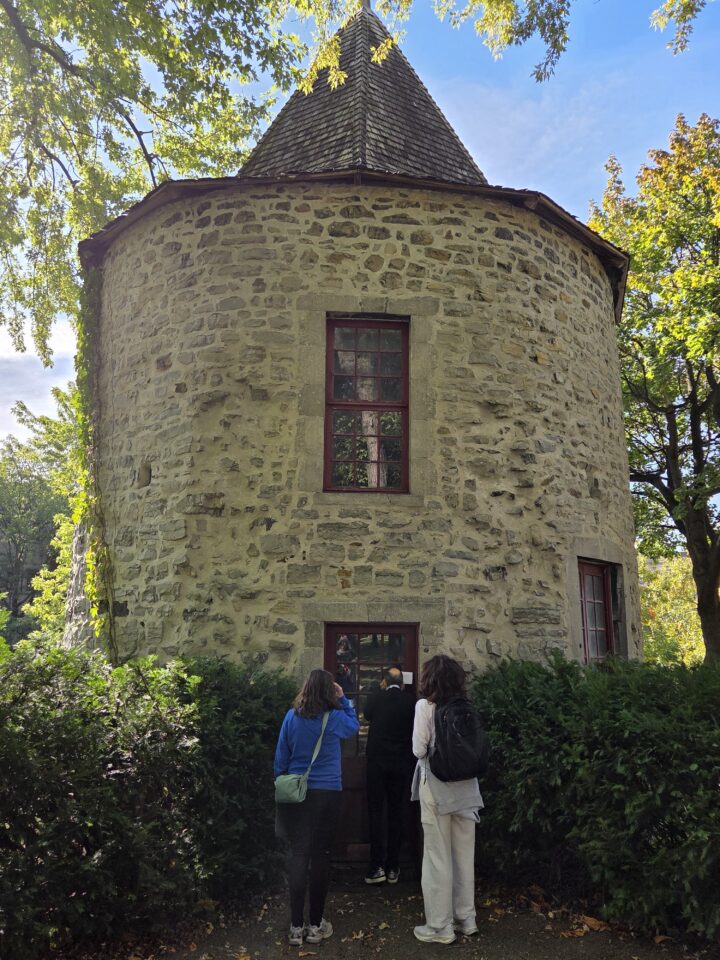
Ben spoke about the nuns, under the guidance of Marguerite Bourgeoys (the founder of the Congregation of Notre Dame of Montreal), who lived at the building that is now Dawson College. He pointed out the N and M emblem on our gates, a leftover from that time. An even more jarring relic from that time were the two towers in front of the Centennial College/ Grand Séminaire de l’Archidiocèse de Montréal. We learned that one of the towers (the other was inhabited by Marguerite Bourgeoys herself) was where young Indigenous people were brought to be evangelized by the Sulpicians. So, in essence, it probably was the first Residential School.
As someone who attended one of the walks, I am very thankful that the College and Ben afforded us this opportunity to learn about the real history of the land and buildings in this area of Montreal.
“I think it’s important to learn about the historical and ongoing colonization of the land we live, learn and work upon if we want to begin a reconciliation process with Indigenous people who are our neighbours, colleagues and friends and whose nations have been upended by the same processes that brought our families to this land and make it possible for us to live here,” Ben said.
Photo and report by Carey-Ann Pawsey