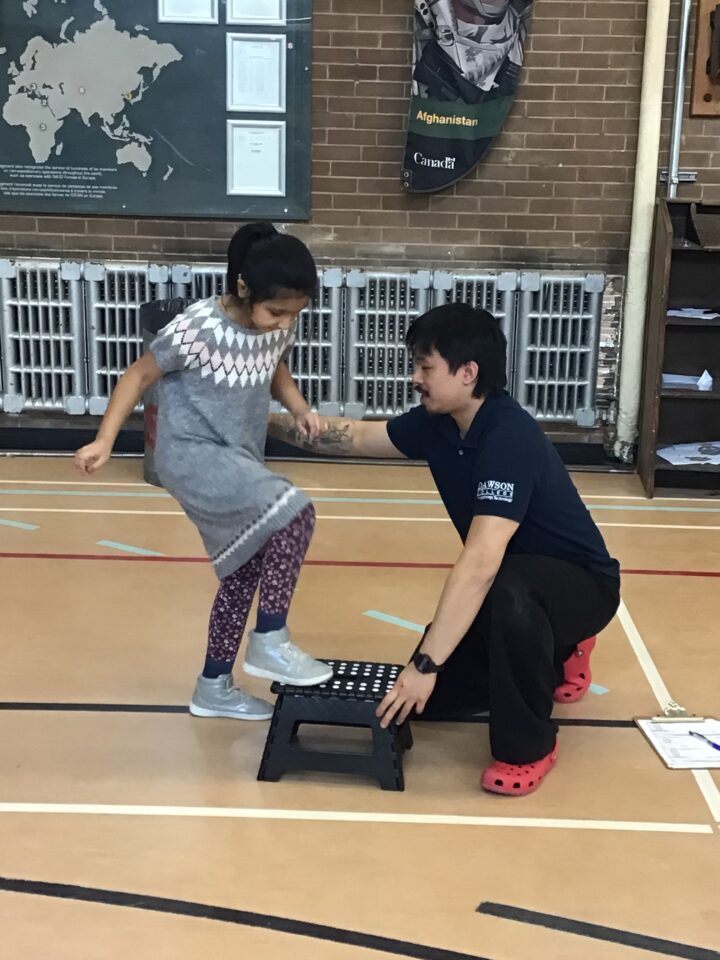
Physiotherapy students do balance screenings for Résonance Montréal school
For the first time, third-year students from the Physiotherapy Technology Program at Dawson College collaborated with pre-school and elementary school students from Résonance Montréal, previously known as the Montreal Oral School for the Deaf, to conduct comprehensive balance and proprioception screenings. The initiative, which took place over a two-week period, marked an important milestone in community partnership and experiential learning in the Physiotherapy Technology’s sixth semester Health Promotion course.
Before Dawson students ever began the balance and proprioception screenings, meaningful groundwork had already been laid. Three professionals from Résonance Montréal visited Dawson College to help prepare the Physiotherapy Technology students for the experience ahead. Their presentation provided essential clinical context, practical insight on communication dos and don’ts, and lived perspective — setting the tone for a thoughtful and informed outreach initiative.
The idea for this collaboration began organically during a lunch conversation. While discussing the objectives of the course, the possibility of connecting Dawson students with children from Résonance Montréal emerged. Kristina Tidy, Physical and Health Education, FSL, and Music Specialist at Résonance Montréal — and a long-time friend of over 15 years — was instrumental in transforming that conversation into action. Her understanding of her students’ needs, combined with her enthusiasm for interdisciplinary collaboration, helped shape both the vision and execution of the project.
As planning progressed, Jenny Alvarado, the elementary school audiologist, joined the team. Her presentation grounded the upcoming screenings in evidence-based practice and helped students understand the physiological connections underlying their screenings. The final presenter, Tracey Green, Director of Student Services at Résonance Montréal, brought an equally valuable perspective. As a graduate of the Montreal Oral School for the Deaf herself, Tracey offered lived experience alongside professional insight. She spoke passionately about advocacy, accessibility, and the importance of understanding the whole child — not simply the diagnosis. Her voice added depth and authenticity, reminding students that culturally responsive and inclusive care is essential.
Together, the three presenters offered Dawson students a rare opportunity to view their future patient population through multiple lenses: a clinical outlook from Jenny, a motor development and school-based perspective from Kristina, and first-hand lived experience and advocacy from Tracey. The session was engaging, reflective, and deeply informative — equipping students not only with knowledge, but with empathy and awareness. By the time the balance screenings began, Dawson students were not simply prepared to administer assessments — they were prepared to understand the community they were serving.
The screening project was designed to assess balance and proprioceptive abilities in school-aged children having a hearing loss. Research has shown that the vestibular system — housed within the inner ear — plays a crucial role in maintaining balance. Because the auditory and vestibular systems are anatomically and neurologically connected, differences in vestibular function can occur more frequently within this population. These differences may influence postural control, coordination, spatial awareness, and overall motor development.
Recognizing this important connection, Dawson’s Physiotherapy Technology students developed and implemented a structured screening protocol under faculty supervision. Over the course of two weeks, Dawson students rotated through assessment stations, guiding children through age-appropriate tasks designed to measure static and dynamic balance, postural control, and proprioceptive awareness. Activities included single-leg stance testing, tandem balance tasks, controlled movement challenges, and functional mobility activities. Following the screening, Dawson students completed screening reports for each student in addition to an exercise program tailored to the students’ needs and special interests.
Beyond collecting objective screening data, the initiative emphasized observation, communication, and adaptability. Students gained firsthand experience modifying instructions, using clear visual demonstrations, and collaborating respectfully within a listening and spoken language educational environment for students with hearing loss. The experience reinforced the importance of inclusive healthcare practices and the use of adaptable communication skills.
For the children at Résonance Montréal the screenings provided valuable insight into their balance abilities and challenges. While many students demonstrated strong balance skills, the initiative also helped identify individuals who may benefit from targeted physical activity, strengthening exercises, or further assessment. Early identification of balance challenges can play a key role in injury prevention, confidence in movement, and participation in sport and recreational activities.
From an educational perspective, the project offered Dawson students an authentic clinical learning opportunity. The initiative aligned with Dawson’s commitment to community engagement and applied learning, bridging classroom theory with meaningful real-world practice.
Most importantly, this first-of-its-kind partnership fostered mutual learning. Dawson students deepened their understanding of how hearing differences can influence motor development, while the Résonance Montréal community welcomed future healthcare professionals into their environment. The success of the screening initiative has laid the groundwork for continued collaboration, with the potential for ongoing annual screenings.
Some feedback gathered from Dawson students:
- Katherine: “Practicing and being exposed to different “clienteles” of children will help me learn how to adjust activities and exercises to suit their needs.”
- Ariane: “It was an amazing experience. I really enjoyed my student. It was a hard goodbye yesterday as he didn’t want me to leave…and I didn’t want to go either!”
This inaugural project reflects the power of community partnership in promoting inclusive, preventative healthcare — and marks the beginning of what promises to be a lasting and impactful relationship between the two institutions.
A special thanks goes out to Vanessa Gangai for her expertise and help in supervising the elementary school students while I oversaw the pre-school group. The day could not have happened without her!
-Submitted by Krista Bulow