Beyond the classroom: neuroscience summer interns built research skills and confidence
From artificial intelligence and brain imaging to mental health interventions and the science of human connection, Dawson students explored a remarkable range of neuroscience topics through the 2026 Summer Internship in Research in Neuroscience.
Coordinated by Dawson faculty members Hélène Nadeau and Sylvia Cox in collaboration with university partners, the internship program gives students the opportunity to participate in authentic research projects at research centres and laboratories in the Montreal area.
This summer, student interns worked on projects spanning neuroimaging, behavioural research, literature reviews and meta-analyses, AI applications in neuroscience, mathematical modelling, mental health, and the study of communication and empathy.
“We were really impressed by the range and diversity of the research projects this summer,” said Hélène and Sylvia. “This diversity allows students with a wide range of interests and backgrounds to participate in research and teaches them how different disciplines contribute to neuroscience and the real world.”
What stood out most to the coordinators was the enthusiasm students brought to their projects, regardless of the field in which they were working.
“We were really pleased with the experience of several new partners at McGill and Université de Montréal,” they said. One graduate student mentor at Université de Montréal described mentoring Dawson students as a valuable learning experience, highlighting how the benefits of the internships extend to both students and emerging researchers.
Exploring solutions to youth mental health challenges
For student Lara Judah, the internship offered the chance to combine her interest in neuroscience with a desire to better understand research.
“I find the field of neuroscience extremely interesting, and I wanted to learn more about what a career in research looks like,” she said.
Lara worked with fellow interns on a systematic review examining the effectiveness of self-guided digital mental health and substance use interventions for youth. The team reviewed more than 15 years of research and extracted data from 94 studies evaluating digital tools designed to support young people dealing with mental health or substance use challenges.
“The systematic review and qualitative studies will give us a better understanding of how we can improve all these digital tools to help youth amidst the current mental health epidemic,” she said.
One highlight of the summer was attending a research conference alongside her mentor.
“It was very inspiring to see all these different kinds of researchers in the same space, sharing their research and progress,” Lara said.
Beyond research skills, she says the experience helped her become more confident.
“This internship forced me to get out of my comfort zone in numerous ways,” she said. “I believe that the internship helped me become more confident in professional and scientific settings.”
Investigating empathy and understanding
For Martin Kaloshi, the internship provided an opportunity to explore the behavioural side of neuroscience, an area that particularly fascinated him.
Working at the Human Connection Science Lab at the International Laboratory for Brain, Music, and Sound Research (BRAMS), Martin studied how people with opposing viewpoints communicate and what factors help them understand one another.
Researchers brought together pairs of people who disagreed on contentious social issues and observed how they interacted, measuring physiological responses and assessing how well participants ultimately understood each other’s perspectives.
“We also looked at how predictive other factors, like empathy and interoception, are of mutual understanding,” Martin explained. “Within the duration of my internship, we saw that higher empathy, for one, seemed to correlate with decreased misunderstanding.”
One of his most memorable moments came after revisiting his approach to analyzing data.
“In the beginning, I took an approach that led to no correlations whatsoever,” he said. “Although this is completely normal in research, it felt disappointing.”
After consulting with his mentors and refining the way he defined empathy within the project, he tried again. “This time, I got real correlations. I was over the moon!”
The experience transformed the way he thinks about science: “As a high school and CEGEP student, science meant learning facts from a textbook,” Martin said. “In fact, science is constantly changing. New ways of looking at old ideas come about and completely change our view of things. Science is alive.”
Martin says working alongside researchers also helped him gain confidence and appreciate the importance of collaboration.
“I consider myself very lucky that everyone at my lab treated me as an equal,” he said. “Being at the lab taught me just how necessary collaboration is for good research.”
Building confidence and independence
According to Hélène and Sylvia, the internships gave students much more than technical research experience.
“Overall, this summer’s internships were very successful and gave our students the opportunity to experience what doing research is actually like in a real-world setting,” they said.
Students encountered both the successes and setbacks that are part of the research process while developing skills in communication, collaboration, flexibility and perseverance.
“Beyond developing research skills, we saw students gain confidence and independence and develop a better understanding of their own interests and strengths,” said the coordinators. “Having access to authentic research experiences in areas that spark their interest at this stage of their education can contribute greatly to their personal growth and help them envision where their future studies and careers might take them.”
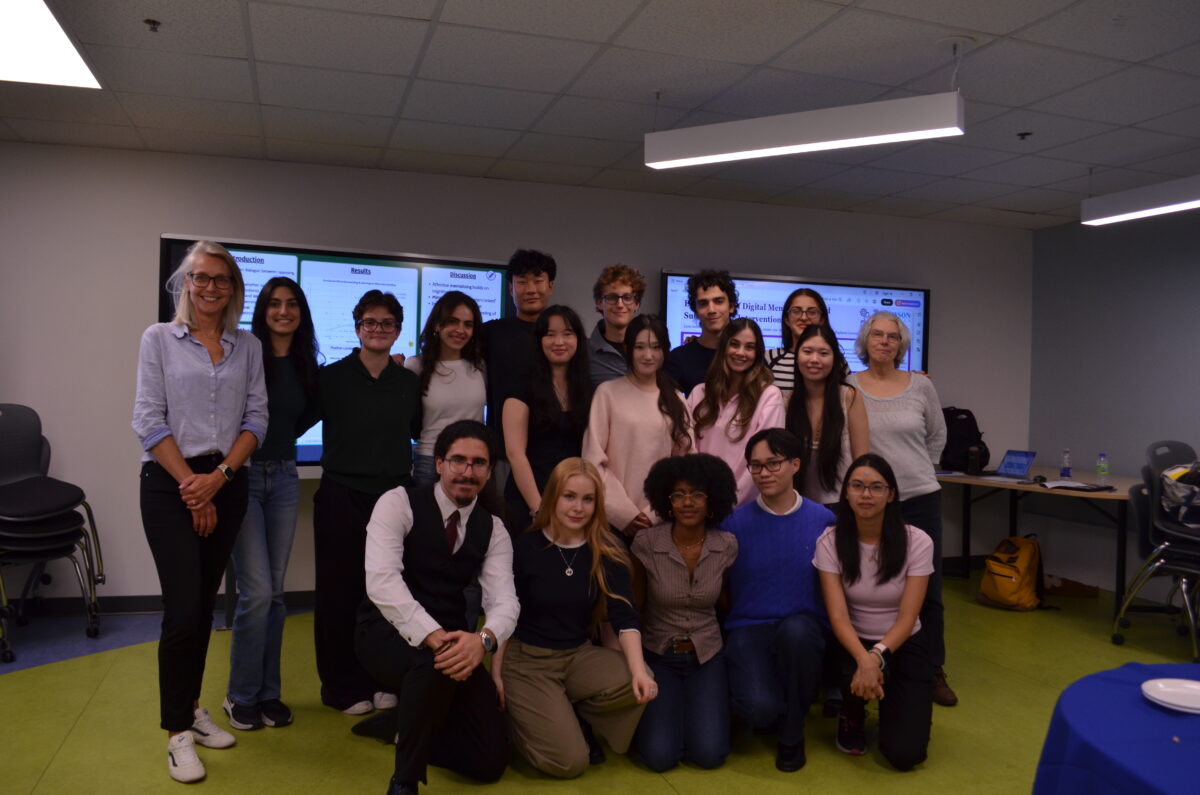
Photo: Summer neuroscience interns with Sylvia Cox and Hélène Nadeau. Photo credit: Vanessa Lyness
The Summer Internship in Research in Neuroscience is funded through CARE’s Internship Initiative (CII). Support for CARE-funded projects is provided by Dawson College, the Collegial Applied Research Ecosystem (CARE), NSERC and the CCI program Mobilize grant.