Cuba through community: reflections from a student delegation
On December 27, 2025, 19 second-year students from the Social Change and Solidarity program, accompanied by two teachers—Sara and Mark—and their supervisor, 5-year-old Amelia, embarked on a three-week solidarity trip to Cuba. While our program provides strong, classroom-based learning, it also emphasizes learning beyond the classroom and looking at the broader structures at play, which is why this trip has been an essential part of the curriculum for several years.
Our partners in Cuba, the Martin Luther King Center in Havana (CMLK), played a central role in organizing and making this experience possible. Throughout the trip, we stayed with host families in their homes where we shared meals, conversations, laughter, and everyday moments that allowed for genuine connection. We traveled across the country, visiting Havana, Viñales, Puerto Esperanza, Playa Larga, and Santa Clara, with our longest stay being ten days in Havana. Along the way we met countless popular educators, farmers, business owners, and community organizations who deepened our understanding of Cuba and solidarity in practice.
The CMLK introduced us to organizations in Cuba that are truly impactful — not just for us, but also on a local and global level. The center itself, a memorial to Martin Luther King, is a place that promotes popular education, support networks, and solidarity. We met artistic organizations that ensure the inclusion of marginalized groups, such as the LGBTQIA2S community, like MirArte and El Mejunje who have built strong communities in their environments and are recognized nationally. We also visited places that support young people by encouraging their art and talents, like La Camorra and Corimacao, which reinforce Cuban culture. Throughout the trip, as we got to know these and many other inspiring organizations, it became clear that Cuba is a place full of life, love, dedication, creativity, and resilience.
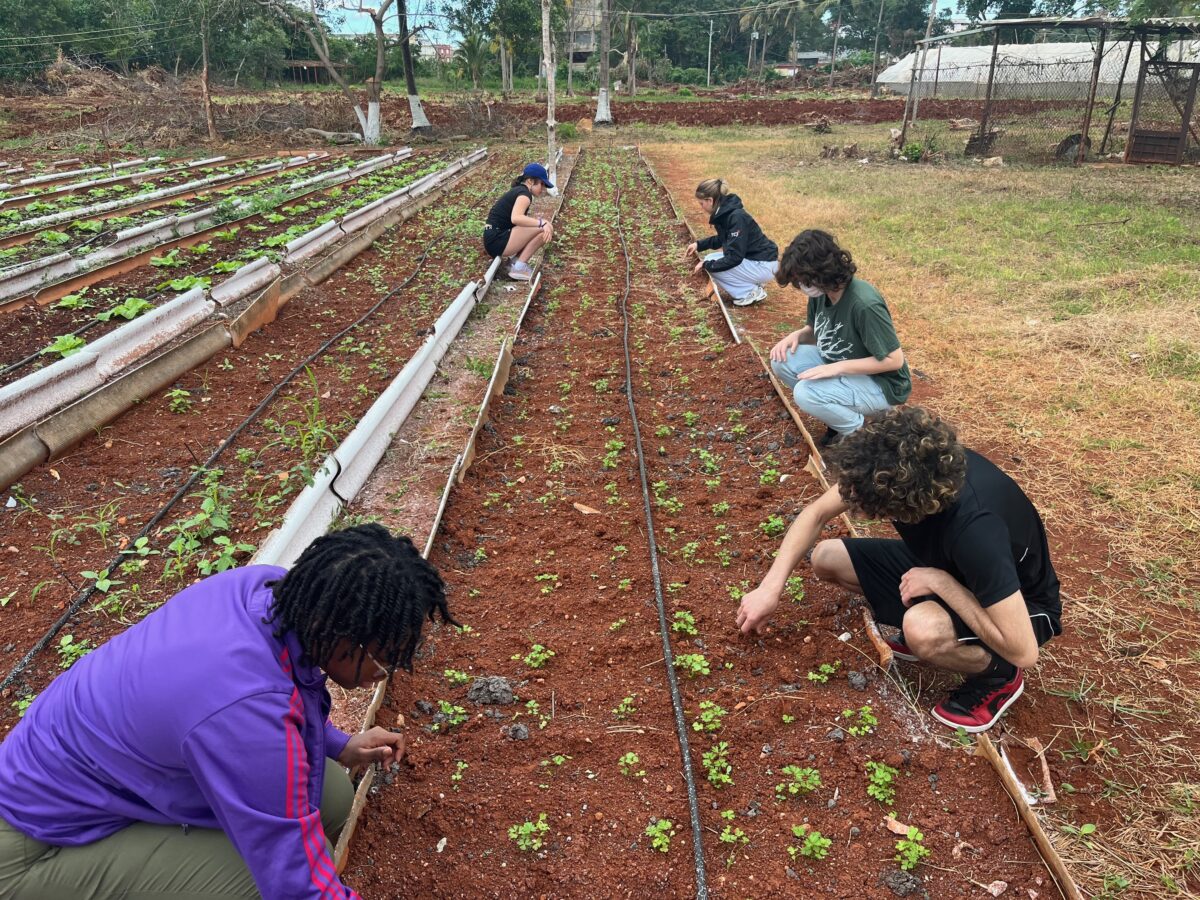
Over the course of our trip, we also had the opportunity to meet plenty of amazing people. From the hosts of our casas particulares who allowed us into their lives through hosting us, cooking for us, and sharing memorable moments and conversations throughout our trip. We met Cubans around our age who dedicated their time to come to the CMLK to share their culture through language, dance and food, and shared their experiences living as young people in Cuba. We met farmers, conservation workers, researchers, popular educators and members of community organisations who taught us about different topics on Cuba’s history, geography, international policy, agriculture, and day-to-day life through many lenses. We are privileged that all these people, and their communities around them, were willing to show us a Cuba that goes deeper than what we can learn in a classroom or through the news.
When talking about Cuba, it is imperative to discuss the blockade that’s been put on the country. We have barely, if ever, heard the term “embargo” used to describe the group of ever-changing laws, sanctions and economic policies and measures imposed by the U.S. on Cuba and any country that participates in trade with the country.
Put in place in 1962, three years after the Cuban Revolution, the blockade’s explicit goal was forcing a regime change in Cuba, as stated in the Helms-Burton Act. However, what is indisputable is its effect on the people of Cuba. Food scarcity, daily blackouts and difficult access to many basic necessities and goods are just some of the many direct consequences of the blockade. The constant changes to these measures have created an immeasurable amount of uncertainty, as Cubans have to constantly navigate new regulations with deep impact on their day-to-day lives.
Just this month the U.S. government has intensified the blockade, blocking oil from entering the country. Although we have the time and ability to analyze the blockade from a political perspective and understand the post-colonial imperial structure that imposes it, the people living it are mainly thinking about figuring out how to manage getting food, medication, fuel and many other necessary goods to live.
Learning about solidarity is easy. We can easily agree that Cuba doesn’t deserve the blockade the US is imposing on it. We can all agree that we must support each others’ cause for a better future. Yet, learning solidarity is another story. It demands questioning values that were instilled in us from a young age.
Going to Cuba and supporting the people we met there felt easy, but when it was time to share food after a long, draining day, to use less water when taking a shower, or to not have access to flushing toilets, we had to face what it really means to be in solidarity with the people around us. It means thinking about a bigger picture rather than our own self-interest. It means understanding that we are part of a collective rather than an isolated bubble. Solidarity means accepting that sometimes we will be uncomfortable, because this is the price of community. Still, it is insignificant compared to the things we can achieve together.
-By Dawson students Anna Gueye, Mariana Duque Antolinez, Janna Yhek, and Keny Manuel Garcia Morillo
The solidarity delegation to Cuba is organized by the Social Change & Solidarity profile, in parallel to an intensive course focused on migrant justice that takes place in Montreal, called Solidarity in Action: A Local Perspective.