Dawson student tackles ER wait times with award-winning project
Everyone can agree that waiting in a Quebec hospital emergency room is a problem that needs solving. Dawson Science student Zhijian (Jian) Sun and his project partner, Vanier College student Nu Kim Anh Ton, have developed a promising solution through their science fair project entitled ERgo.
Jian loves solving complicated problems. “Everyone who’s been to the ER knows the endless wait, and when you look at the data, Quebec ERs are among the most overcrowded in the country,” he said. “I wanted to know: is there a smarter way to prioritize patients and reduce those wait times? The answer to that question became ERgo.”
He described the project as “a discrete-event simulation of an emergency room modeled on the Royal Victoria Hospital using real MSSS (ministry of health) provincial data. It lets you simulate an ER under different triage policies and measure outcomes like wait times and patient flow. What makes it innovative is that it can test policies that don’t currently exist and quantify their impact in real time. This dynamic design allows it to easily integrate into a real clinical environment.”
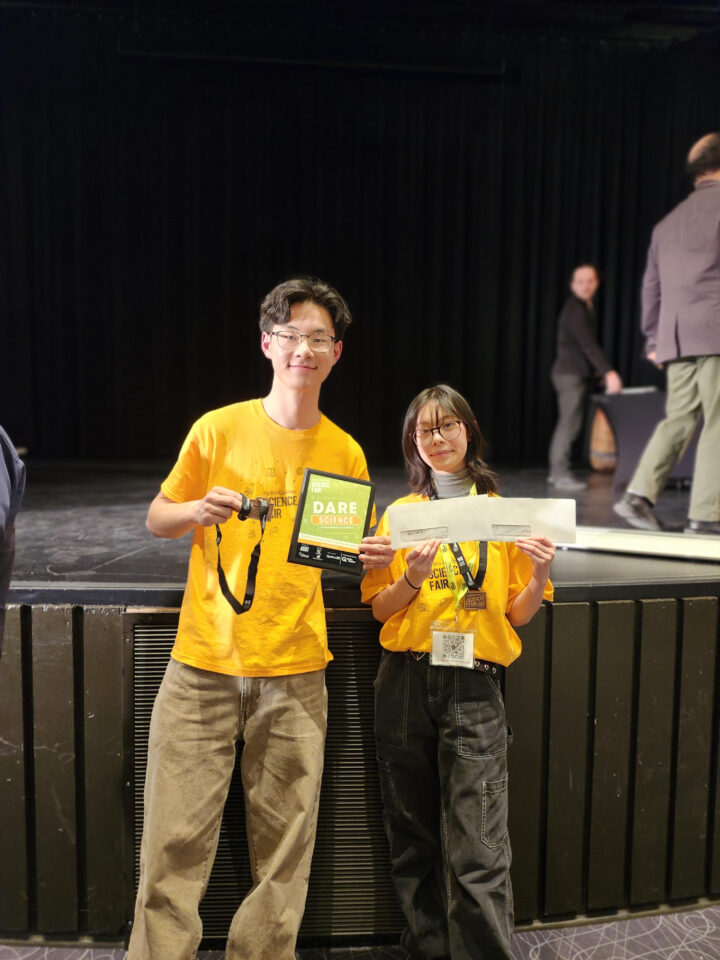
ERgo earned multiple awards at a regional science fair last month, including the McGill University Math and Statistics Award, the McGill University Redpath Museum Award, and the bronze medal at the collegial level. As a result, Jian and Nu were selected to represent the Montreal region in the provincial competition—Super Expo-Sciences Hydro-Québec, finale québécoise—taking place at Université Laval this weekend.
Jian is excited to meet fellow participants and explore their ideas. “I’m curious to see what everyone is working on, and I’m hoping to exchange with researchers and judges who specialize in healthcare to bring our project to the next level,” he said.
This is Jian’s first experience participating in a science fair. “We poured a lot of hours into this project,” he said, “so hearing our name called once was already a huge relief! Advancing to provincials felt like confirmation that the problem we’re studying actually matters and that ERgo has real potential to grow.”
For Jian, the most challenging part was “calibrating the simulation so it reflected the real-life data accurately.” Presenting the project to a panel of experienced judges was also an exciting learning experience that both partners feel proud of.
When asked what advice he would give to students considering a science fair, Jian emphasized passion over prestige. “Pick a problem you actually care about instead of one that sounds impressive. It’s much easier to make something you care about impressive than the other way around. Completing a science fair project is long and tedious, and caring about the problem is what keeps you going when you run out of gas.”
He credits his programming class at Dawson for helping him develop the project’s technical foundation. “Learning Python in my programming class at Dawson was incredibly useful when building the simulation engine. I’m also grateful to have met many like-minded people at Dawson who inspired me to tackle this problem in the first place.”
Jian also thanked the Dawson Foundation and the College for their support. “A huge thank you to the College and the Dawson Foundation for supporting me with the registration fees. Their support is essential to keep this project going. Last but not least, I want to give credit to my wonderful teammate from Vanier, Nu Kim Anh Ton. ERgo wouldn’t exist without her, and I couldn’t be prouder of our journey these past couple of months.”