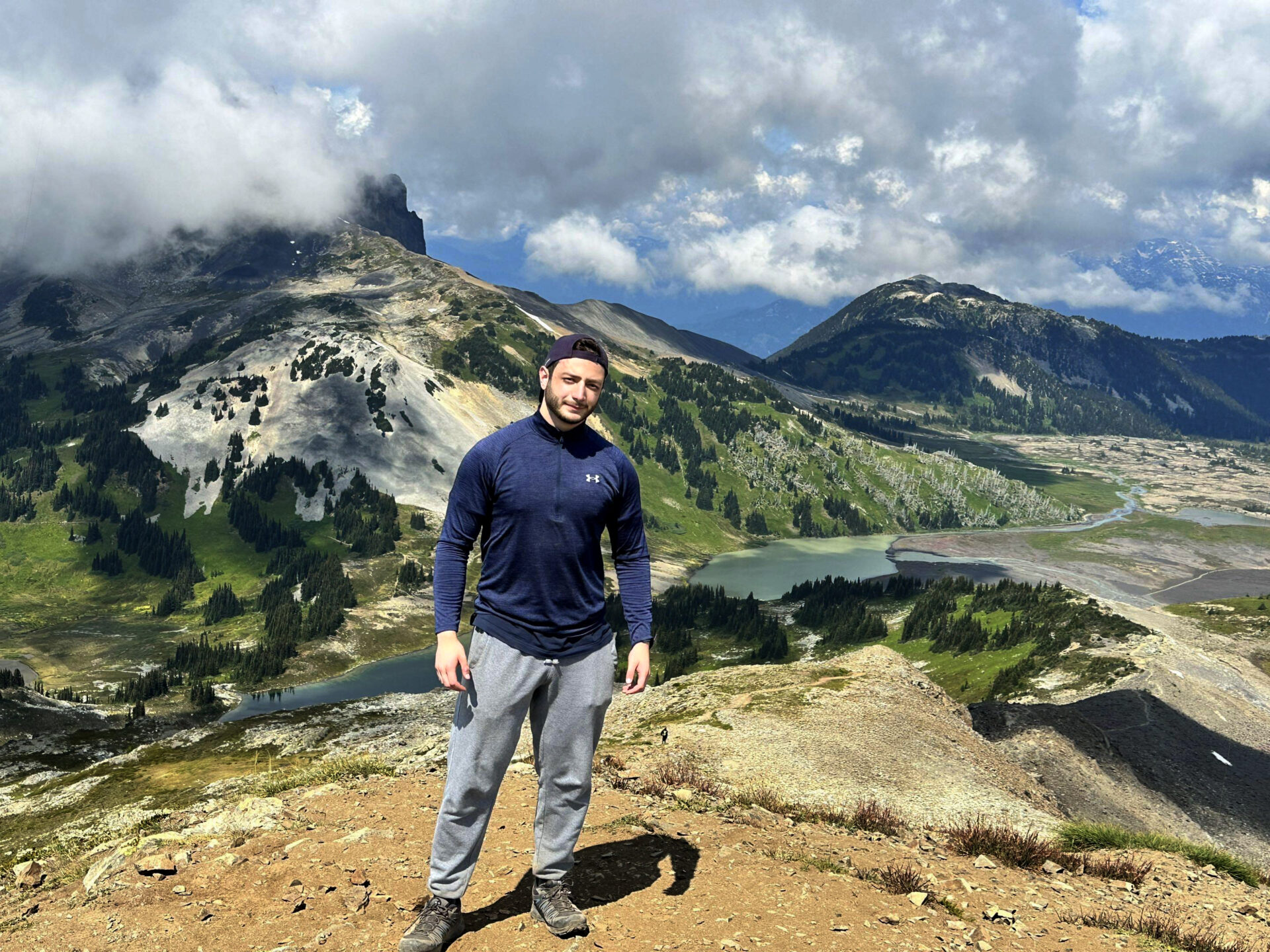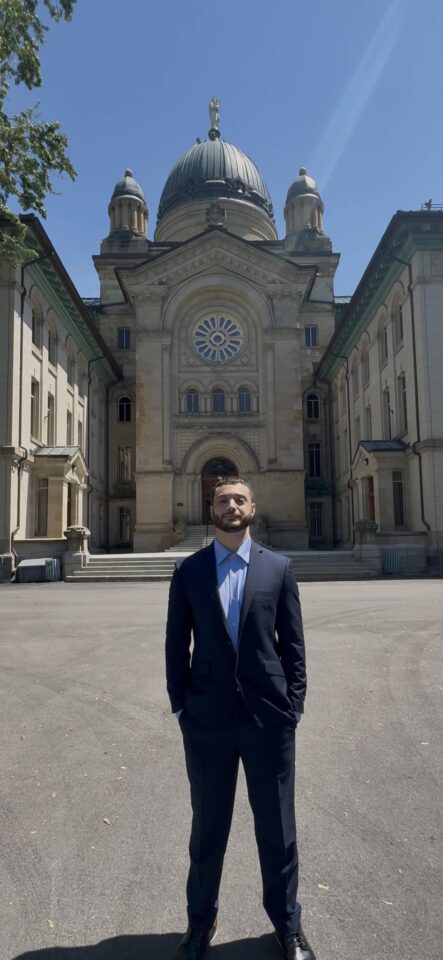
Representing the Class of 2026: Julien-Alexandre Pinard takes the stage
At Dawson College, the role of valedictorian reflects more than academic excellence. It recognizes students who have made a meaningful impact on their community while demonstrating leadership, determination and a strong sense of purpose.
As the Class of 2026 prepares to graduate, two valedictorians have been selected to represent their peers at the June 23 ceremonies.
Julien-Alexandre Pinard will address graduates at the afternoon ceremony. A student in the Education, Family and Childhood profile of Social Science, he distinguished himself not only through his academic work, but through his commitment to making a difference in the field of education.
Throughout his time at Dawson, Julien developed a clear sense of direction, discovering a passion for teaching. He worked closely with faculty and peers to highlight the importance of representation in education, particularly encouraging greater male presence in the field.
His journey reflects perseverance and self-belief, shaped by challenges that ultimately reinforced his confidence and ambitions.
The Communications Office interviewed Julien, and we present the Q & A:
How have you grown in your time at Dawson, as a student, as a person?
Julien-Alexandre Pinard (JP): When I first arrived at Dawson College, I had no confidence in my academic abilities. I was just hoping to pass. When I had exams, I would try and achieve a 60 per cent. I had spent my entire life being told by the system that school was not for me. Two years later, I finished CEGEP on the honours list every semester with a 90 per cent average. The biggest growth for me was not academic. It was learning that I can ask for help, attend office hours, and trust that the people teaching me actually wanted me to succeed. Once I understood that, everything else followed.
Which class or subject challenged you the most, and how did you overcome those challenges?
JP: English classes were the ones that challenged me the most at Dawson. Thankfully, I had amazing English teachers such as Andrea-Lynn Strudensky who brought my essay writing skills to the next level. I had completed English 101 without really knowing how to write a strong essay, and her teaching changed that. In Alyson Grant’s 103 English class, I was humbled from the very start with a 30 per cent quiz, but I was able to bounce back and finish the class with a 90 per cent. By the time I reached Michael Duckett’s Integrative Seminar with the topic of Indigenous Canada, I was already much stronger, perfecting my essays under his guidance while also learning deeply about Indigenous communities. I overcame these challenges by attending office hours when help was needed, not hesitating to ask for feedback, and trusting that improvement would come from repetition. When I arrived at Dawson, English was one of the subjects I was the most afraid of, and now I am leaving Dawson with it as the subject I’m the most proud of.
Who was your favourite teacher or mentor, and how did they influence your academic path?
JP: Cynthia De Luca was one of the most influential teachers I had at Dawson. She was not only the first teacher who held me to a higher standard but also helped me on a personal level, making me realize that my past was in fact my greatest asset. But Cynthia is one of several teachers who shaped me. My profile coordinator, Nancy Rebelo, gave me the opportunity to have personal involvement at Dawson and allowed me to participate in something bigger than myself. Marie-Pierre Gosselin made me discover something I’d never thought I’d find: a love for higher education. Kasia Wolfson, Timothy Slonosky and Anastasia Arvanitidis gave me tremendous support with countless office hours, which leveled up my academic confidence.
What are the highlights of your overall life at Dawson? In other words, what activities, clubs, sports, projects did you participate in here and what did you learn or appreciate from your involvement?
JP: One of the things I am the most proud of during my time at Dawson College is the direct institutional impact to my program. The EFC Profile Coordinator, Nancy Rebelo, and I managed to increase male representation in the profile. When I started CEGEP, only about 5 per cent of students in the profile were men, and many of us go on to teach or work with children. I committed to participating in several events to help normalize men in education. By the time I graduated, male enrollment in the profile had climbed to 17 per cent. Helping make that more visible at Dawson was one of the most meaningful things I did here, because my impact will outlast my time at this school.
What inspired you for your speech and why did you decide to apply? Or perhaps there is a particular story you would like to share.
JP: I decided to apply for valedictorian because I think I am the proof that you can always surpass your doubts. For most of my life, I was told I’d never be able to complete CEGEP. Failing year after year and yet finishing as valedictorian is proof that anyone can achieve what they set their minds to. My hope is that someone reading this and doubting themselves will have the courage to aim even higher.
What advice do you have for the incoming students at Dawson?
JP: Work with your teachers. No one wakes up in the morning wanting to fail you, rather they want you to succeed more than anything. Go to office hours, ask questions, ask for feedback, ask for help. The students who do well at Dawson are not always the ones who walked in the smartest. They’re the ones who took advantage of the resources and had enough agency to use them. Once you start using them, everything else gets easier.
What are your plans after graduation, and how did your time at Dawson shape those goals?
JP: This fall, I’ll be continuing my studies at McGill University in Education. I have a deep desire to work within the education system to better support students who are being told what I was told growing up. But teaching alone is not enough, I want to advocate for systemic change in our education system that is built for only one single learner, rather than individualized to each. My time at Dawson has taught me that the students the system writes off deserve teachers who refuse to see that label, and a system willing to learn from them.
Read Julien-Alexandre’s full Valedictorian speech.