The Lottery of Immigration
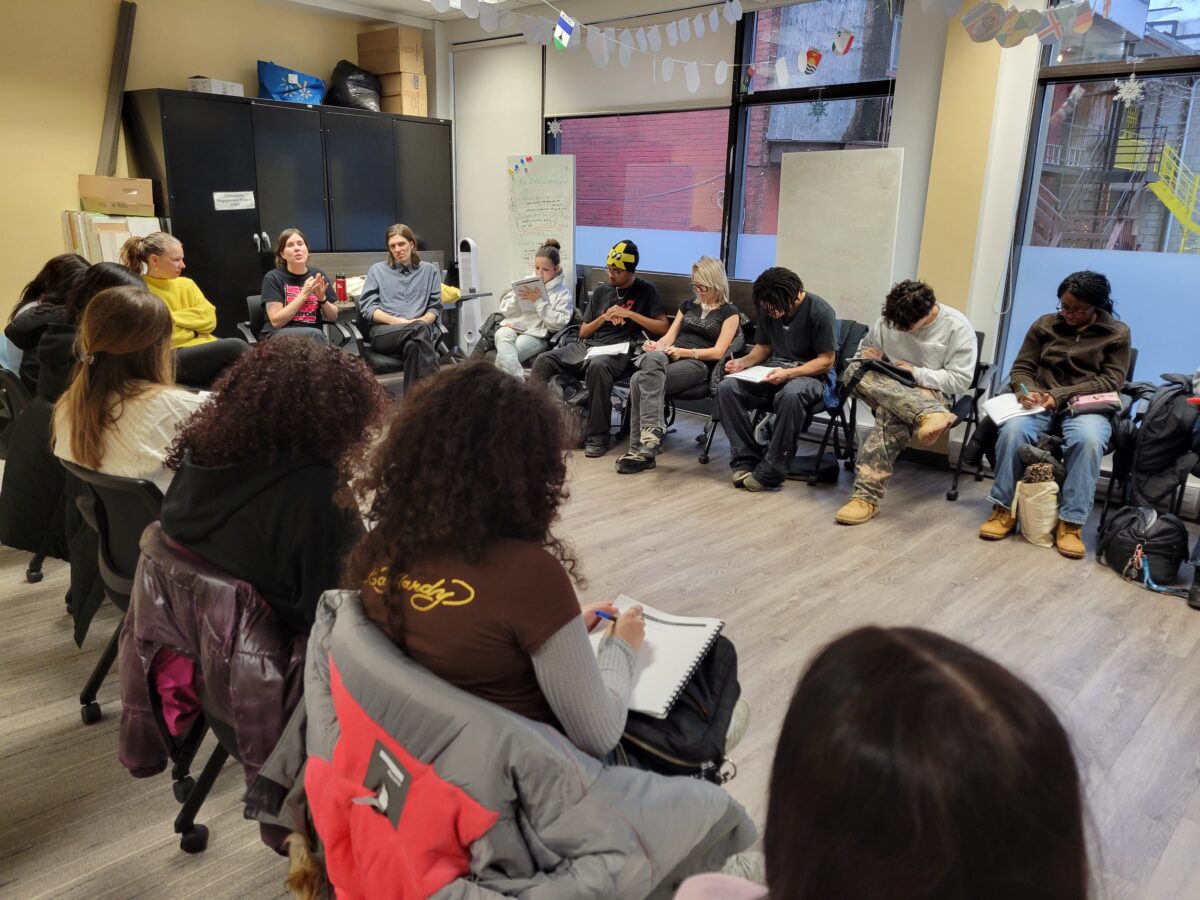
As part of an intensive course this winter on Migrant Justice, we visited multiple organizations that devote themselves to migrants and help them with their struggles. In a class of around 25 students, we were led by Benjamin Lander, our teacher, to explore Montreal through the lens of migration. This adventure took place between Jan. 13 Jan. 16; we met for several more days in March. Our itinerary in January consisted of five organizations: The Immigrant Workers Center, the JIA Foundation in Chinatown, The Refugee Center, Welcome Collective, and Solidarity Across Borders. Each of these resources shed light on fundamental issues immigrants and undocumented people are faced with on the daily.
The Organizations
The Immigrant Workers Center (IWC) acts as a resource for migrant workers. Often, companies profit from these workers, overwork them or lay them off without justification. That power is attributed to them since the workers are in a precarious position, therefore, fear is utilized against them. The IWC supports and organizes migrant workers, offering legal advice, a safety and social network, and a place to fight issues together.
The JIA Foundation fights to maintain the culture of Chinatown. With the rising issues of gentrification, Chinese communities are creating many programs to revive this place and stop its destruction. Many youth groups have formed to draw the community back and demonstrate the cultural and historical importance of Chinatown. Its origin dates to the creation of the Canadian Railroad and the systemic racism the Chinese population faced, despite being the backbone of this innovation. To this day, many Chinese citizens have the Head Tax certificate of a member of their family. The government is still trying to erase the unappealing moments of Canadian history without rectifying it.
We also met three lawyers at the Refugee Center who work to process refugee claims, fight off deportation, and protect people with sensitive situations. The lawyers described the heaviness of this field; many lawyers had to manage multiple cases at a time; requests can take years to be granted, and sometimes, deportations are inevitable. The legal aspect of migration is a hassle to navigate. The lawyers illustrated it as ‘walking against the wing’: fighting a system that was made to keep migrants out.
The Welcome Collective equips newcomers with necessary household goods that one would need. From refrigerators to mattresses, the organization ensures that all are well furnished. They are always open to donations. You can either go and give the furniture directly to the center, or you can ask them to pick it up for a small fee that goes to families in need.
Solidarity Across Borders (SAB) is a migrant justice network fighting for regularization and status for all. They organize protests, mutual aid, and much more to prioritize the safety of human beings rather than letting them be tortured for not having citizenship.
Bill C-12
Bill C-12, an anti-immigration law, enforces the walls around the border. It would allow the government new powers to cancel a person’s immigration application for arbitrary reasons and without due process. This bill would increase deportations and detentions. For a country that takes such pride in Canadian heritage and casts judgement on our neighbours down south, this sounds much like ICE, and not the kind that fills our roads in the grip of winter, the kind that dehumanizes someone based on their status. It is a law that is unjust, created without any consultation of the affected groups. A law that the majority would never accept for themselves – a law that degrades people. According to Martin Luther King, that is the definition of an unfair law.
Personal note and experiences
Through this intensive, we had the opportunity to enrich ourselves with knowledge from these organizations and their goals. A deeply fulfilling interaction we had was with the members of Solidarity Across Borders that we met who live with precarious status or without status. Their stories were deeply moving. All of them showed us their resilience and strength.
One of the members of SAB told me that she “is a mother who is not allowed to be sick”. She could not be weak, she had to be strong for her daughter – a daughter who wants to be a nurse but can’t because to access post-secondary studies, you need status. She had to be strong to support her two other children, who were on other continents because she could not bring them close to her. She had to be strong despite seeing her younger son be killed. This is the reality of many migrants, especially those with precarious status. They do not steal jobs or benefit from healthcare; they are exploited, all because they were not lucky enough to be born in the right place, at the right time. They lost the lottery of citizenship.
It is a privilege to have citizenship, and we ought to demonstrate solidarity with those who do not have it. A piece of paper should not be the determining factor for kindness towards one another. Solidarity is standing beside those who are oppressed; it is showing forth a united front against this exploitation. The beauty of solidarity is that it comes in various forms, from protests to spreading awareness to the simple presence of someone who will listen. We live in a place that constantly tries to separate us by gender, ethnicity, beliefs, fields of study, and more. We tend to forget, we are all humans.
-By Social Change and Solidarity student Marie-Noël Chayeb
Solidarity in Action: A Local Perspective is organized by the Social Change & Solidarity profile, in parallel to the Field Trip to Cuba (Solidarity in Action: A Global Perspective).