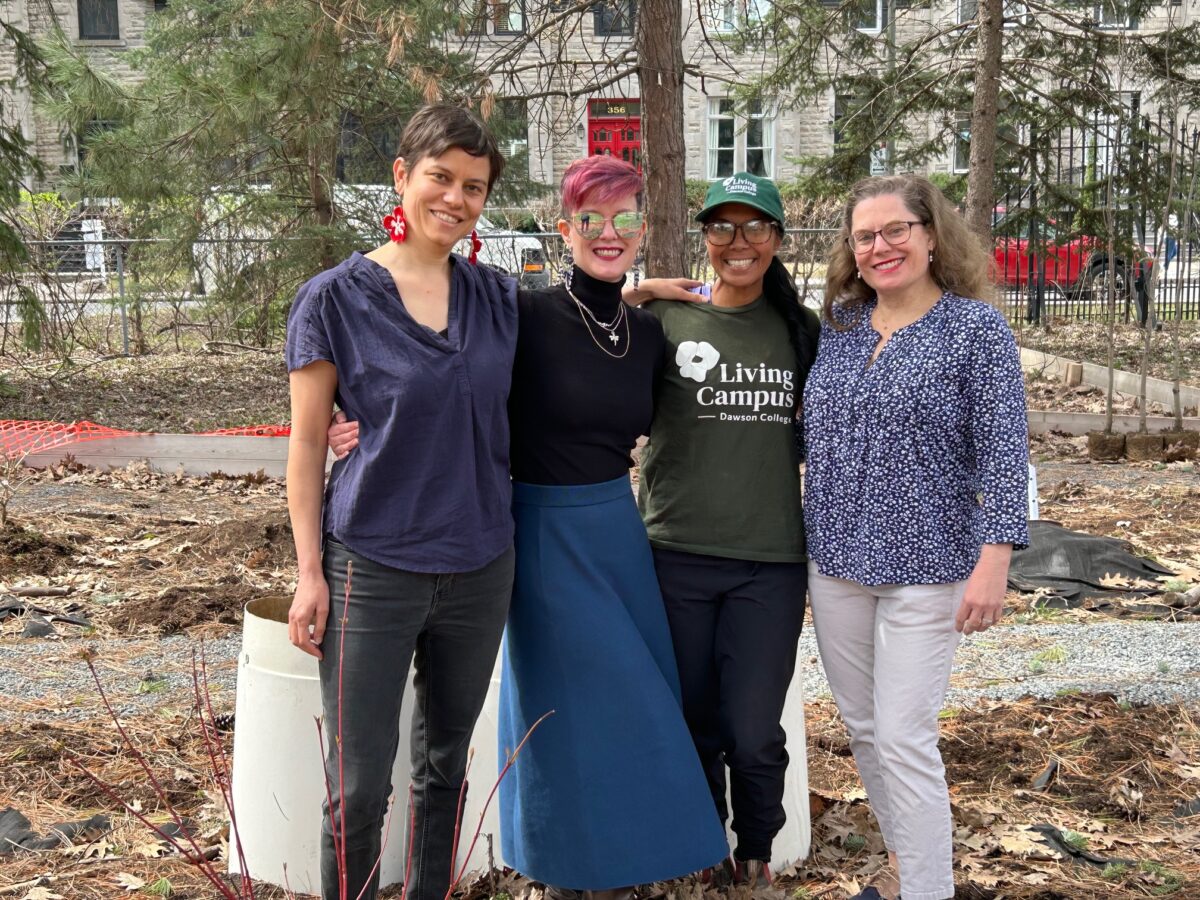
Dawson advances Living Campus with new micro forest initiative
Despite budget constraints, the Office of Sustainability at Dawson College advanced the vision of the Dawson community’s campus landscaping plan last fall by launching a micro forest initiative.
After Jennifer de Vera identified a funding opportunity from Colleges and Institutes Canada (CICan), she brought it to the team. Along with Eva Helms, Sophie La Font and Diana Rice, they applied for a grant to create a micro forest with guidance from the First Peoples’ Centre and Kanienʼkehá꞉ka staff.
Diana, who wrote the successful grant application, said: “I suggested we apply for a modified version of a micro forest, focusing less on softwood fast-growth trees and more on Indigenous Haudenosaunee hardwoods that eventually become old growth trees. Thus, in the long term, greenhouse gas reduction and carbon sequestration are more effective.”
The team aimed to “align our department’s mission with the 2024-’29 Strategic Plan of Dawson College in terms of Indigenization; awareness building activities on environmental sustainability; supporting innovative evidence-based pedagogies like experiential and active learning through the inclusion of classes in the planting, data collection, and maintenance of the site,” Diana said.
The micro forest also provides faculty with an opportunity to use it within the Living Campus model as a competency and learning outcome-based educational tool.
The idea originated during a 2024 trip Jenn and Sophie took to Canadore College in North Bay, Ontario, where they participated in a three-day Sustainable Innovation course and helped plant a micro forest. “We planted tree saplings with the group and created a micro forest on their campus using the Miyawaki Method,” Jenn said. “I always wanted to duplicate that project at Dawson.”
After receiving the grant last fall, the team moved quickly to plant the micro forest on the west side of the campus, as all activities had to be completed by February 2026.
The project aligned with Jenn’s final assignment for her Sustainable Urban Agriculture certificate at the University of Guelph. “With guidance from the First Peoples’ Centre, we got a list of native plants. I found a wonderful local nursery called Jardin Buzz. I told the owner that we were building a micro forest with only native plants, she put together many native plants and bushes for us. I thought we would have the spring to plant, but I had to rush to get everything ready for our first dig-in micro forest day on Oct. 22. Despite the rain, we had students from the Environment and Sustainability Certificate, Sustainabili-team student volunteers, and two of Adamo Petosa’s classes.”
“Our Living Campus motto is reconnecting people, community and Nature, and this project did exactly that,” Jenn said. “We were able to bring the community together and build a new space on campus that will benefit everyone. We added a crushed rock path around and through the micro forest ensuring it is wheelchair accessible.”
Diana said students are already planning projects connected to the site. “Biology students will be tracking the variety of Native plants and tracking the increase in biodiversity over time. Chemistry students will be testing the soil. We added our vermicompost castings, which is high in nutrients. They will monitor the growth of plants compared to plants that do not have any castings,” she said.
Upcoming activities include:
- Kanienʼkehá꞉ka students and employees leading medicinal plant workshops.
- Kanienʼkehá꞉ka students painting a large planter with Indigenous sacred animals.
- Illustration students painting Nature-themed images on wooden planters built by Dawson’s Facilities Management staff, which will house edible berries.
- Sustainabili-team volunteers maintaining the micro forest.
- Research Methods students observing plant species and pollinator activity.
- A French course translating plant care and maintenance instructions.
- Environment & Sustainability Certificate students receiving credits for volunteering.
- Mechanical Engineering Technology and Civil Engineering Technology students assisting with builds using upcycled metals.
- Product Design lab technician creating signage.
Earlier this year, Jenn and Diana presented the project at a national community of practice series hosted by CICan. Their project was selected by the organizers due to “its strong ecological impact, community engagement, and alignment with national sustainability priorities.”
When sharing the project with other CEGEPs and colleges, Jenn emphasizes the importance of involving the community: “I always look within our own Dawson community for support. Which programs could benefit from this project and use it continuously as a living lab? Why hire externals when you already have students and employees who are willing—and eager—to be involved? When the community gets their hands dirty (pun intended), it creates a sense of ownership over the space, which in turn encourages long-term care and stewardship.”
The micro forest offers multiple benefits:
- Increasing biodiversity, improving soil health, decreasing greenhouse gases on campus and reducing the heat island effect.
- Serving as a living lab with hands-on learning opportunities across disciplines.
- Encouraging connection to the natural world.
- Decolonizing our land and recognizing the importance of Indigenous knowledge and the history of the land by designing a uniquely Haudenosaunee version of a micro forest.
- Creating a self-sustaining ecosystem that contributes to climate resilience on campus.
- Providing a lasting symbol of Dawson’s commitment to sustainability and education.
The Office of Sustainability invites faculty to explore how the micro forest can be integrated into their courses. Contact sustainability@dawsoncollege.qc.ca.