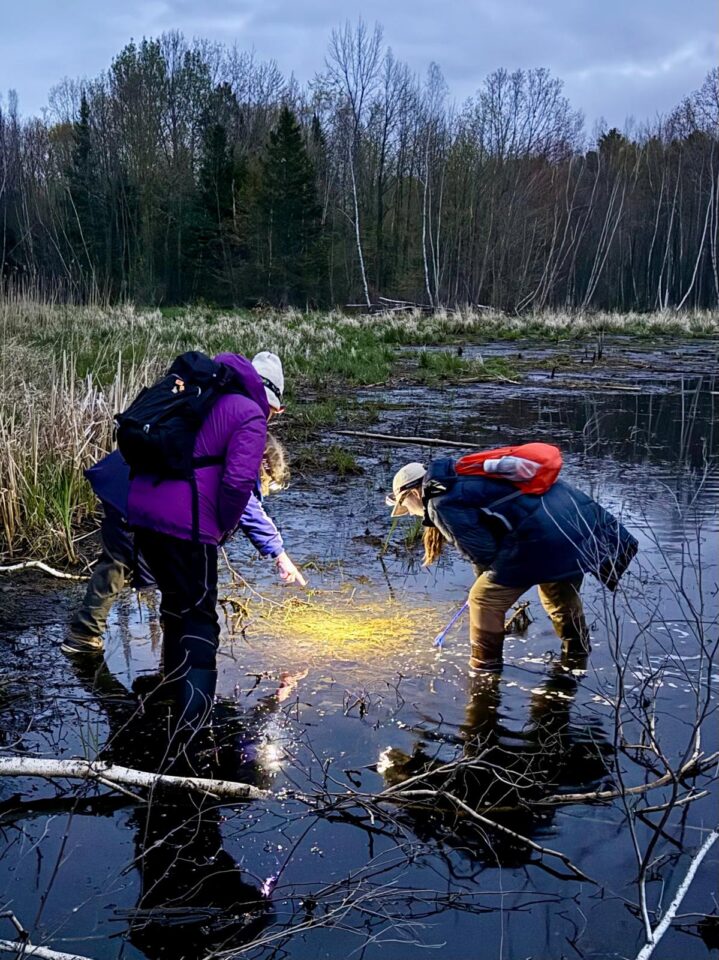
Dawson research team listens to frogs to understand Canada’s lakes
In winter, Canada’s lakes fall quiet as if everything has gone to sleep. Then spring arrives, bringing with it the unmistakable chorus of frogs. This season, Dawson Biology faculty member Jessica Ford and her students are tuning in to that chorus, contributing to a five-year, cross-Canada multidisciplinary research project that explores how human activity is reshaping the country’s lakes.
“My research on amphibians, their preferred habitats, and how habitats change when amphibians use them for breeding or not, will be useful in understanding the role amphibians play in these lake ecosystems,” Jessica said.
Jessica is hoping to detect changes in amphibian ranges by identifying new or previously unknown populations.
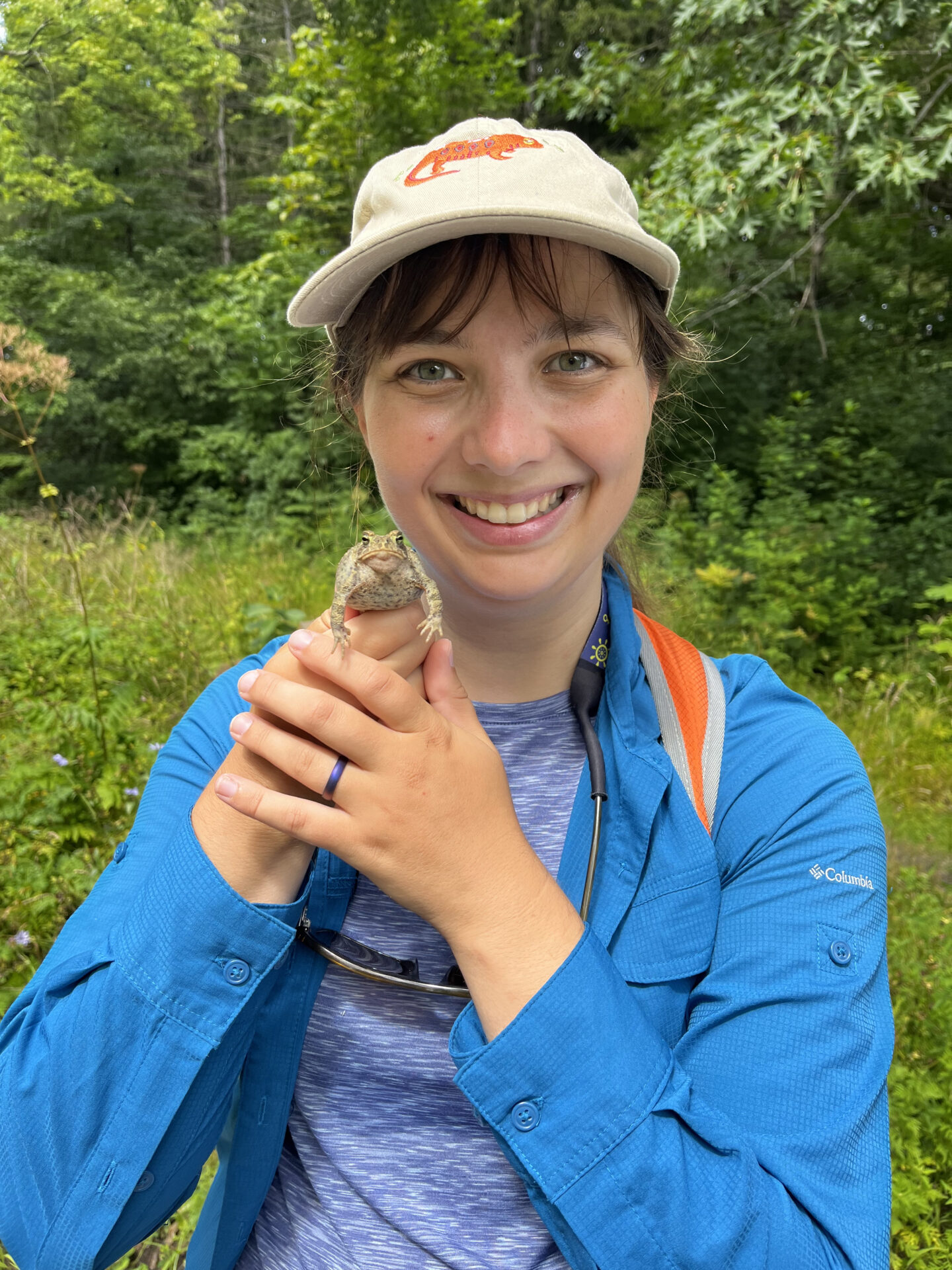
Jessica in the field with one of her research subjects.
“Frogs and toads are nocturnal, and only call for a portion of spring and summer depending on the species, so sometimes if no one is looking for them specifically, they can be missed!
“In lakes, the tadpoles of frogs and toads have a huge biomass, a single toad can lay thousands of eggs in one breeding season! Through my PhD work, I found that these tadpoles can have cascading effects through pond ecosystems, affecting the amount of nutrients, algae, and zooplankton, and thus are important to understanding the health of an aquatic ecosystem. The acoustic surveys tell us if the adult frogs and toads are breeding in a specific location, and the eDNA results could let us know if tadpoles are present, even if we don’t see them ourselves.”
Students will be out listening, too: “As a teacher, being part of a big scientific initiative like this shows students how much the work we do matters, and the bigger picture that our nights catching frogs and testing water quality falls into. …This helps them see themselves in future science roles as well.”
Currently, Jessica is recruiting students to join the Ford Aquatic Biology Tadpole Lab (FAB TADS) at Dawson. They will be working at field sites including Creek 53 in Hudson, Mount Royal and Bois-de-Liesse parks.
The accessibility of this opportunity should allow a diversity of students to participate, and Jessica believes their contributions will be unique: “The problems we face in ecology right now need ideas and solutions from lots of minds, with lots of ideas and ways of looking at the world. The work these students are doing with me at our field sites is crucial to collecting real data that helps us better understand ecosystems.”
Jessica enjoys bringing students into the field and listed many benefits: “Students have told me that hands-on research experience in the field has improved their confidence and sense of belonging in science, their love for and connection to Nature, and improved their mental health. I feel so lucky that I get to introduce students to hands-on field research and show them not only how real-life conservation initiatives work, but how they can be part of that effort. I love the reptiles and amphibians; it means the world to me to foster that appreciation of nature in my students as well.”
Jessica’s research contributes to a five-year study directed by Professor Yannick Huot from the Department of Geomatics at the Faculté des lettres et sciences humaines of the Université de Sherbrooke. The project received a $5 million grant from the Natural Sciences and Engineering Research Council of Canada (NSERC).
For more info and to follow Jessica’s portion of the project:
- Jessica’s research lab website: https://jessicafordscience.wixsite.com/fabtads
- And this is our Instagram for field pics and, importantly, pictures of cute amphibians: https://www.instagram.com/fab_tads/